

THE FRAMEWORK · THE STANDARDS OF THE HOUSE · STUDY NO. 01
The Watchmaker’s Standard
Ten lessons the old horological houses offer the design, launch and management of financial systems.
THE FRAMEWORK · STANDARDS

STUDY NO. 01
Abstract
Luxury is not the performance of luxury. It is the finishing of surfaces no one will inspect.
X-CHASE takes its method from the old houses of horology. This document sets out what that means in practice, lesson by lesson, and states each lesson as an obligation the House holds itself to rather than as a claim about itself.
The reason horology is the correct model is narrower and more useful than the reason usually given. It has nothing to do with the aesthetics of luxury and everything to do with a shared condition: a watch and a financial institution are both machines that must run correctly, unattended, for decades, in the hands of an owner who cannot see inside them. Everything in the horological method descends from that single fact. Because the owner cannot inspect the mechanism, the house cannot rely on his inspection to enforce quality. It must therefore enforce quality against itself — and that is what the finishing of hidden surfaces is, what voluntary certification is, and what a two-hundred-year servicing commitment is. None of those practices exists to impress a client. Each exists because the house understood that in an object of this kind, the only real guarantee is the standard the maker holds when nobody is watching.
Ten practices transfer directly. They are set out in Exhibit 1 overleaf and then taken in turn: the position of the établisseur, the discipline of the métier, the primacy of the drawing board, the act of réglage, the movement understood as an algorithm, the finishing of invisible surfaces, the voluntary standard, the doctrine of constant force, the register, and the obligation to service the object for as long as it exists. Each is documented from the published practice of houses and certifying bodies, and each is translated into a clause of the Standard of the House.
Definition · The Three Propositions
First — An institution, like a movement, is judged over decades and inspected by nobody. Its quality is therefore whatever its maker enforced in the absence of an inspector.
Second — A house that assembles what others manufacture is not thereby a lesser house. Its craft is specification, selection, regulation and finishing, and it answers for the whole.
Third — A standard is only a standard if it is written down, if it is stricter than the law requires, and if the body that enforces it is not the body that profits from passing.
Section I sets out the ten lessons in summary. The sections that follow take each in turn, in the order in which a house actually performs them — from the position it occupies, through the way it is organised, to the way it builds, measures, records and maintains. The penultimate part states what the House itself publishes and what would falsify it; the final part states the twelve clauses. A reader with limited time may read Exhibit 1, then Part Three, then the clauses, and will have the argument.
Exhibit · The Course of the Standard
- IWhat Is Actually Taken From the BenchPart One · The Inheritance
- IIThe ÉtablisseurPart Two · Lesson One
- IIIThe Métier, Not the DepartmentPart Two · Lesson Two
- IVThe Drawing Board Comes FirstPart Two · Lesson Three
- VRéglage — The Adjustment of the Assembled WholePart Two · Lesson Four
- VIThe Movement Is an AlgorithmPart Two · Lesson Five
- VIIThe Finishing of Invisible SurfacesPart Two · Lesson Six
- VIIIThe Voluntary Standard, in NumbersPart Two · Lesson Seven
- IXThe Three Rules That Make a Standard RealPart Two · Lesson Seven, Continued
- XWhat the House Publishes, and What Would Falsify ItPart Three · The House Measured by Its Own Rule
- XIConstant ForceLesson Eight
- XIIThe Register, and the Numbered ObjectLesson Nine
- XIIIService for the Life of the ObjectLesson Ten
- XIVThe Twelve Clauses of the Watchmaker’s StandardPart Three · The Standard
What Is Actually Taken From the Bench
Financial firms have invoked watchmaking for thirty years and taken almost nothing from it, because the invocation is nearly always visual: heavy paper, a gear-wheel in a logotype, the word craftsmanship applied to a spreadsheet. That is the performance of luxury, and precisely what the great houses do not do. Patek Philippe does not photograph its finishing; it performs the finishing on the underside of a bridge that will be seen once in a generation, by a watchmaker, in another country, long after the founder is dead.
What follows is a list of practices rather than impressions. Each has a name in the trade, a documented method, and a direct institutional counterpart.
Exhibit 1 — The Ten Lessons
| The practice on the bench | In a financial system | |
|---|---|---|
| I · The établisseur | The house commissions components it does not manufacture, then assembles, adjusts and signs the whole | Design, selection, integration and governance of third-party infrastructure — owning the standard rather than the factory |
| II · The métier | Organisation by craft, each bench held by a master who may refuse to release work | Capabilities as benches rather than service lines, and capacity that limits volume |
| III · The drawing board | The calibre is fully specified before a single part is ordered | Architecture before procurement — the design owned by the principal before a vendor is approached |
| IV · Réglage | The assembled mechanism is adjusted by hand until it holds its rate | The institution is tuned as an assembled whole; component selection alone achieves nothing |
| V · The algorithm | Every ratio is fixed in tooth counts at the drawing board; the movement executes and never judges | What will be decided under pressure is encoded in advance; the sequence of assembly is not negotiable |
| VI · The invisible surfaces | Hidden bridges are bevelled, polished and grained though no owner will see them | Termination clauses, reconciliation, data dictionaries, change control, escalation, offboarding |
| VII · The voluntary standard | A published tolerance, verified by a body that does not profit from passing | A codified governance standard adopted before any licence requires it |
| VIII · Constant force | Peak torque is sacrificed so that force reaching the escapement stays constant | Dimensioning the institution for its depleted state rather than its opening month |
| IX · The register | Every object numbered; the records never destroyed; extracts issued centuries later | A reference on every document, an archive of decisions, and a method that improves by accumulation |
| X · Service for life | The obligation to keep the mechanism alive runs with the object, not with the sale | The management mandate, and Transfer understood as the school rather than the exit |
Source: X-CHASE analysis (House Framework), from the published practice of the houses and certifying bodies named in this document.
Anyone can polish the dial. The house is identified by the interior angle — the corner a machine cannot reach and a client will never see.
Lesson One · The Établisseur
In the valleys of the Swiss Jura from the eighteenth century onward, watches were not made in factories. They were made by farmers and former textile workers in their own houses through the long alpine winters, each producing a single class of component — wheels, bridges, screws, springs, dials — and each becoming, over a working life, the best in the valley at that one thing. A figure called the établisseur supplied the raw material, commissioned the parts, collected them, assembled the movement, regulated it, cased it, put his own name on the dial and answered for the result in the market. The system was called établissage, and on its strength Switzerland came to out-produce British watchmaking by a wide margin within a few decades.
Read that description again with a financial institution in mind, because it is not an analogy. It is the same structure, and it is the structure X-CHASE occupies deliberately. The House does not manufacture the core banking platform, the liquidity, the custody, the payment rails or the trading infrastructure, and does not claim to. It specifies them, selects among them, negotiates them, integrates them, regulates the assembled whole, and answers for it. The word for that position is not consultant and it is not vendor. It is établisseur — a word with a two-hundred-and-fifty-year record, and one recently and deliberately revived: in 2026 Audemars Piguet returned to Geneva and named a new workshop programme the Atelier des Établisseurs, presenting the assembling house not as a compromise but as a tradition.
Exhibit 2 — The Register of Houses
| Founded · Founders | The practice taken | |
|---|---|---|
| Vacheron Constantin | 1755 · Geneva — Jean-Marc Vacheron (1731–1805), master of Saint-Gervais; François Constantin from 1819 | The unbroken register — production recorded every year since foundation |
| Breguet | 1775 · Paris — Abraham-Louis Breguet, who patented the tourbillon in 1801 | Constant force, and the numbering of every object made |
| Fontainemelon (FHF) | 1793 · Fontainemelon — Isaac and David Benguerel with Julien and François Humbert-Droz | The specialist supplier — the ébauche the assembling house finishes |
| Patek Philippe | 1839 · Geneva — Antoni Patek with Franciszek Czapek; Adrien Philippe from 1845 | A seal of the house’s own, stricter than the law, plus service for life |
| Audemars Piguet | 1875 · Le Brassus — Jules-Louis Audemars, aged 23, and Edward-Auguste Piguet, aged 21 | The établisseur — named as a tradition rather than a compromise |
| Poinçon de Genève | 1886 · Canton of Geneva — Instituted by cantonal law rather than by a founder | The voluntary external standard, enforced by unannounced audit |
Source: Founding dates, founders and certification history per the public record of the houses and bodies named. Referenced solely to describe established practice; no affiliation is stated or implied. No portrait or proprietary image is reproduced.
The tradition carries its own warning, and the House takes it as part of the inheritance. The assembling model prospered where the standard was held and degraded where it was not. Four guards follow, and are written into the Standard: every counterparty named and reachable, a published floor with the specification never the variable, one codified method applied identically, and ownership of the method, the archive and the measurement — the three things no supplier can repossess.
Lesson Two · The Métier, Not the Department
A watch house is not organised by product. It is organised by métier — by craft. There is a master of the movement, a master of the case, a master of the dial, a master of the hands; there are separate métiers d’art for engraving, enamelling, guilloché work and gem-setting, each with its own bench, its own tools, its own apprenticeship and its own succession. A junior does not rotate through them. He is placed in one and stays for a decade.
The difference between a métier and a department is accountability for a craft rather than for a deliverable. A department is measured on output; a métier is measured on standard, and it may refuse to release work. That is why the House states its capabilities as capabilities and not as service lines: each is a bench with a master, and each holds a veto over its own portion of the assembled institution.
Exhibit 3 — The Movement in Plan, and the Bench That Answers for It
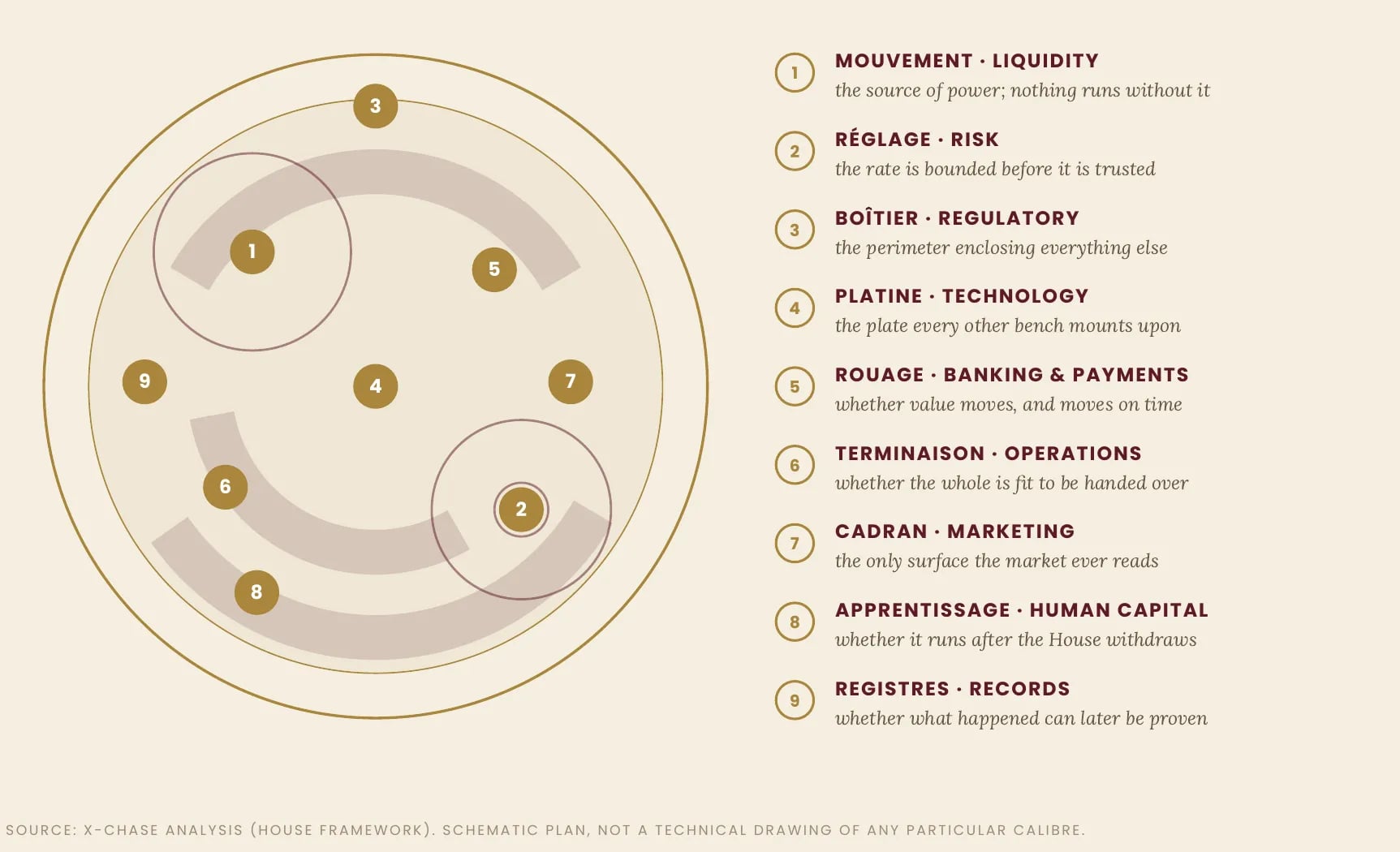
Two working rules follow. A bench is never staffed by a generalist, and the House would rather hold an engagement than fill a bench with someone who cannot hold its standard. And a master is not fully a master until he has trained the person who will replace him — in horology the school, in the House the Transfer phase.
There is a commercial consequence that the trade understands better than our industry does. A bench can finish only so much work in a year, which means volume is set by capacity and not by demand. The houses that kept their standard kept their output below what the market would have absorbed, because the alternative to declining an order was releasing work that did not meet the standard. This is the honest content of horological scarcity: not a marketing device but an arithmetic constraint, honestly observed. A signature means something only for as long as the house is willing to withhold it.
Lesson Three · The Drawing Board Comes First
No house commissions a component before the calibre exists on paper. The architecture of the movement — its layout, its going train, its power reserve, the space allotted to every future complication — is settled first, in drawing, and the specification of each part is derived from it. Only then is a single wheel ordered. The reason is not method for its own sake: a movement is a system of tolerances, and a part specified before the whole is a part that will fit nothing.
The conventional path into a financial institution runs in exactly the opposite direction, and it does so for understandable reasons. A principal decides to establish a firm and the first substantive conversations are with vendors — a platform provider, a liquidity provider, a licensing agent — each competent, each answering the question put to him, and none positioned to ask whether the structure being assembled is the right one. By the time the architecture becomes visible it has already been selected: by the platform that determined the client segment, by the jurisdiction that determined the banking constraint, by the liquidity arrangement that determined the dependency. The design was made. It simply was not made deliberately, and it was not made by the owner of the capital.
Exhibit 4 — The Order of Operations
| A · As commonly built — procurement first | B · As drawn by the House — design first | |
|---|---|---|
| 1 | Vendors are met. Platform, liquidity and licensing each answer only the question put to them. | The whole is specified: objective, capital, jurisdiction, structure, tier and origin of profit — settled on paper. |
| 2 | Components are bought. Each is individually reasonable; none is chosen against a whole. | Every part is derived from the design: technology, liquidity, regulatory pathway, banking, organisation, capital schedule. |
| 3 | Architecture emerges, and is discovered in month fourteen. The remedy is not adjustment but rebuild. | Procurement begins, against a specification the principal owns and may take elsewhere. |
Source: X-CHASE analysis (House Framework).
A part specified before the whole is a part that will fit nothing. The order of those two words is the difference between an institution and an assembly of vendor contracts.
This is why the House sells the design as a discrete, paid, fixed-scope piece of work whose deliverable is an architecture rather than an introduction, and why it holds no economic interest in which vendors are subsequently chosen. A drawing made by someone who is paid by the parts is not a drawing.
Lesson Four · Réglage — The Adjustment of the Assembled Whole
In horology to regulate does not mean to comply. It means to adjust an assembled mechanism, part by part, until it holds its rate. It is performed after assembly, by hand, by the most senior person in the building, and it is the step that separates a box of excellent components from a watch. A movement built entirely from best-in-class parts, unregulated, keeps poor time — and the parts are not at fault.
This is the single most under-appreciated lesson for our industry, because it is the one that cannot be bought. Any principal with capital can procure an excellent platform, an excellent liquidity arrangement and an excellent licence. What he cannot procure is the adjustment of those three against one another under load, which is a skill exercised on the assembled institution and nowhere else. Regulation in this sense is also not a phase that ends. It is a loop, and the loop is what compounds.
Exhibit 5 — The Trace, Before and After Réglage
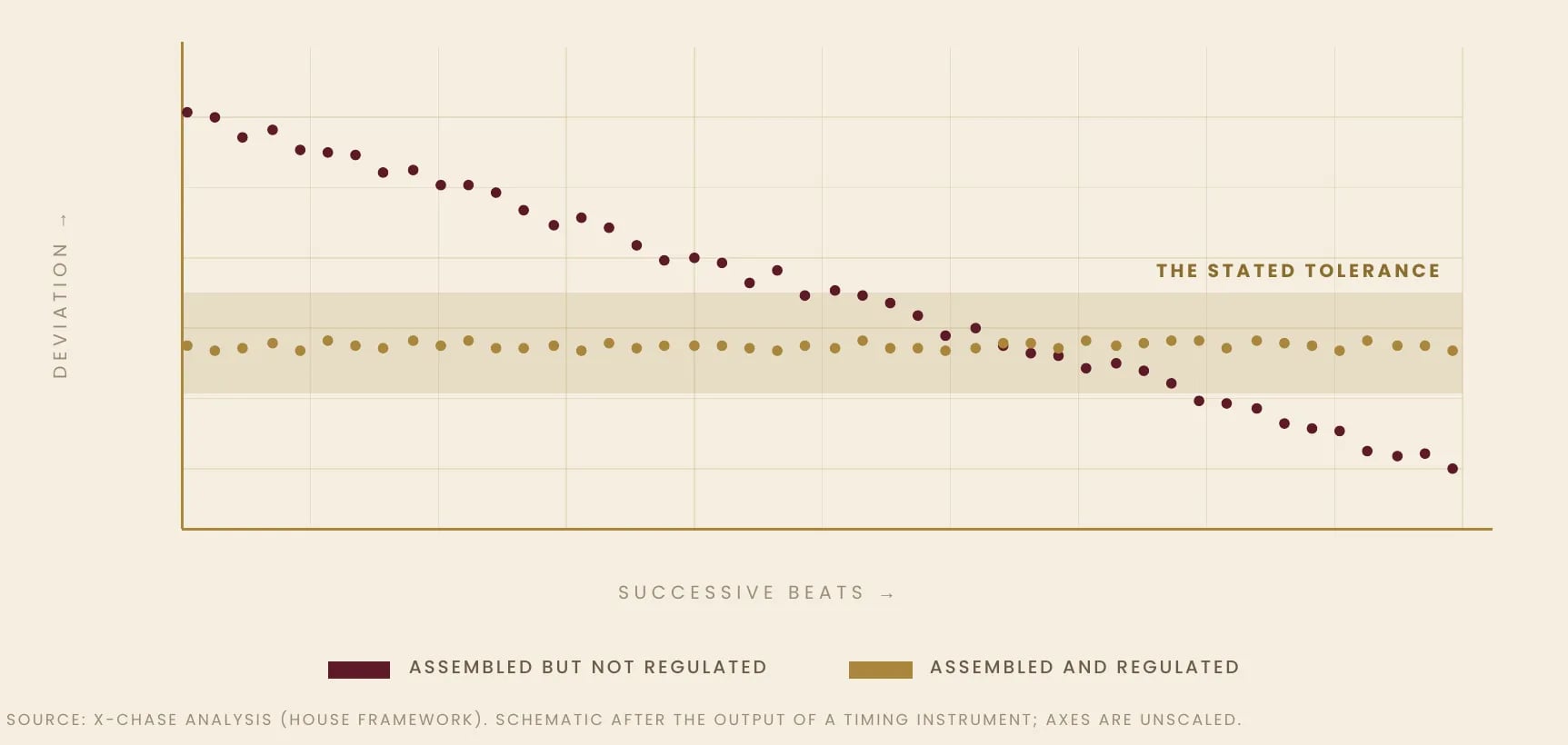
Two consequences. The first is that a house with ten years of recorded adjustment is difficult to displace, and that the correct opening move for a new house is therefore a narrow one: accumulate more measured history than anyone else in one structure, one jurisdiction, one asset class, and widen afterwards. The second is that the same records which prove the result to the principal are the records that prove it to a supervisor. Built once, they serve both; treated as a brochure, they are built twice.
Lesson Five · The Movement Is an Algorithm
A mechanical movement is a deterministic algorithm expressed in metal. Nothing in it is decided while it runs. The mainspring supplies force; the going train divides that force by ratios fixed in tooth counts chosen years earlier; the escapement converts a continuous push into discrete, identical beats. A modern movement running at four hertz produces twenty-eight thousand eight hundred of them in an hour, six hundred and ninety-one thousand two hundred in a day, and a quarter of a billion in a year — and not one of those numbers is an estimate. They are arithmetic, settled before the first part was cut.
The watch, in other words, does not exercise judgement. It executes. Every judgement was made at the drawing board and then frozen into geometry, which is precisely why it can be trusted for decades by an owner who never opens it. This is the deepest and least imitated lesson in the whole of horology, and it is the one financial institutions get wrong most expensively.
Exhibit 6 — The Going Train as a Fixed Chain of Ratios
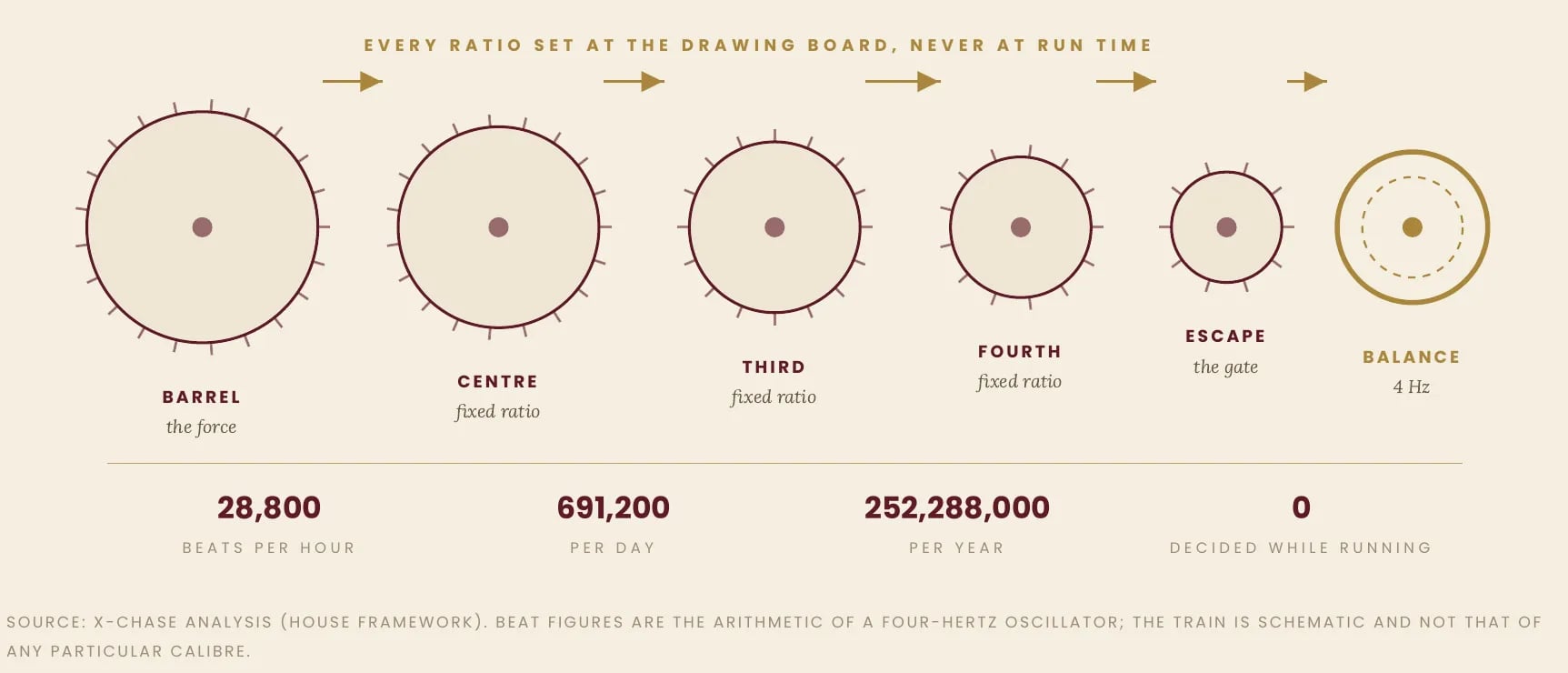
A movement has no discretion, and that is the source of its reliability. An institution has too much, and that is the source of its drift.
The transferable rule is stated plainly. Anything that will have to be decided under pressure should be decided in advance and encoded — an exposure limit, an escalation threshold, a margin trigger, a rejection rule. These are tooth counts. Where they are instead computed at the moment of stress by whoever happens to be present, the institution has no rate at all; it has an average of the temperaments of its staff.
The rule has a mirror image, and the mirror is the harder discipline. A gear train has no discretion whatever, and an institution cannot be built that way, because some decisions genuinely require judgement and no rule anticipates them. The craft is knowing which is which — and the House allows only two categories. If a decision recurs, it is encoded. If it is genuinely singular, it is escalated to a named person against a named deadline. There is no third category, and the sentence we will decide when it happens is not a design.
Exhibit 7 — What Is Encoded, and What Is Escalated
| The decision category | Where it lives, and who may move it | |
|---|---|---|
| Exposure and concentration limits | Encoded | In the pre-trade layer. Changed only by written revision, never by the desk that trades against it |
| Margin and collateral triggers | Encoded | In the risk engine, with the calculation documented and reproducible |
| Client acceptance | Encoded | Against a written standard; every rejection carries a reviewable rationale |
| Incident escalation | Encoded | In the matrix: who is called, in what order, within what time |
| Model release | Encoded | In the change-control file, with an authoriser who is not the author |
| Substituting a provider | Escalated | Named committee, named deadline, written record of the alternative considered |
| Fee exception | Escalated | Above the published floor only; the specification is never the concession |
| Entry to a new jurisdiction | Escalated | Treated as a new drawing, not as an extension of an existing one |
Source: X-CHASE analysis (House Framework).
And the Sequence Is Also Fixed
Order is the second half of this lesson. A movement is assembled in one sequence and only one: the plate before the bridges, the train before the balance, the dial last. A step taken out of order is not corrected by adjustment; it is corrected by disassembly. Watchmakers do not treat this as bureaucracy. They treat it as the physical shape of the object.
The institutional sequence has the same property and is routinely violated because violating it feels faster. A licence cannot be sensibly applied for before the entity and the business it will actually conduct are settled. Providers cannot be integrated before the specification exists, because integration to an unwritten specification is simply the vendor’s specification adopted by default. Clients cannot be onboarded before reconciliation runs, because the first error will then be discovered by someone outside the firm. Each of these, taken out of order, is remedied by disassembly — and disassembly of an institution is financed at the worst possible moment.
Lesson Six · The Finishing of Invisible Surfaces
Open the back of a fine watch and you will find work that has no function. Bridge edges are bevelled and polished to a mirror — anglage; a lever is polished until the steel reflects black — poli noir; the plate beneath the dial, which the owner will never see, is grained in overlapping circles — perlage. None of it makes the watch keep better time. And the most reliable indicator of a genuinely high house is the treatment of the interior angles of a bridge, because a machine cannot cut a sharp internal corner: it must be finished by hand, with a file, by someone senior, on a surface nobody will ever photograph.
This is the answer to what luxury is. Luxury is not the surface the client sees; the market imitates that surface, cheaply. It is the surface he will never see, finished to the same standard as the one he will. A house that finishes only the visible face has not made a more affordable luxury object; it has made a different category of object, and the trade knows which.
Exhibit 8 — The Interior Angle

Exhibit 9 — The Invisible Surfaces of a Financial Institution
| Why it is never inspected by the owner | What its finish determines | |
|---|---|---|
| The termination clause of a vendor agreement | It is read once, at signature, by nobody senior | Whether the institution can ever change provider |
| The reconciliation procedure | It works, and is therefore invisible | Whether a loss is found in hours or in months |
| The model and change-control file | It is produced for a regulator who may never call | Whether the institution keeps its permissions |
| The offboarding and data-portability plan | It contemplates an ending, at a beginning | What the institution is worth to a buyer |
Source: X-CHASE analysis (House Framework).
The commercial objection should be stated plainly: the client does not pay for the invisible surfaces, because he cannot evaluate them. That is true, and not a reason to omit them. It is the reason the House charges for a method rather than for hours, and publishes the method — so the invisible work becomes, in its specification at least, visible before it is bought.
There is a harder corollary, and it is the operative definition of luxury in this trade. A high house scraps a finished bridge for a mark no owner would notice, because the standard is a threshold and not an average: a part either meets it or it is destroyed, and there is no discount for being close. The institutional translation is exact — a deliverable that does not meet the specification is not shipped with a note explaining the shortfall. It is done again, at the House’s cost, before anyone outside sees it.
Lesson Seven · The Voluntary Standard, in Numbers
Horology’s most transferable invention is not a mechanism. It is the practice of publishing a tolerance and submitting to a body that measures it. Note what the following certifications have in common: not one is required in order to sell a watch. Every one is voluntary, every one is stricter than the law, and each was created by houses that wanted a floor they could be held to.
Exhibit 10 — What the Houses Submit Themselves To
| Tolerance | What is actually tested | |
|---|---|---|
| COSC · Chronometer (since 1973, to ISO 3159) | −4 / +6 sec per day | The uncased movement over fifteen days, in five positions and at three temperatures — 8°, 23° and 38°C — against seven separate criteria, none of them rounded |
| Poinçon de Genève (cantonal law, 1886) | Finishing, plus rate | Component finishing to a prescribed specification; assembly, adjustment and casing must occur in the canton. Extended from 2012 to the whole cased watch, with surprise audits of the houses themselves |
| Qualité Fleurier (a consortium of Fleurier houses) | Cumulative | Requires prior COSC certification, adds ageing and shock testing, then runs the finished watch on an articulated arm that simulates a day of wear |
| METAS · Master Chronometer | 0 / +5 sec per day | The cased watch, including resistance to a magnetic field of 15,000 gauss and verification of the stated power reserve |
| COSC · Excellence (announced 2026) | −2 / +4 sec per day | Chronometer certification first; the cased watch then returns for five further days, including twenty-four hours on a robot simulating wrist wear |
| The Patek Philippe Seal (the house’s own, 2009) | −1 / +2 sec per day | Over sixty-five criteria across the entire watch, measured on kinetic simulators after casing — and a commitment to service every watch the house has made since 1839 |
Source: Published criteria of the respective certifying bodies and houses, as at the date of publication. Named houses and bodies are referenced solely to describe industry practice; no affiliation is stated or implied.
Read the tolerance column downward. A house that wanted only a marketing claim would have stopped at the first row, because the certificate reads identically to a buyer. Instead the sequence tightens, and the tightening is voluntary at every step: the same industry that could have settled for six seconds a day went to five, then four, then two — and in the last case a house left the oldest certification in the world in order to hold itself to a stricter one of its own making.
One objection should be met directly, because a reader who knows the trade will raise it. The house whose seal is strictest is itself a full manufacture, vertically integrated to the point of producing its own cases — the opposite of an établisseur. But a seal and a servicing obligation are instruments of governance, not of production, and they transfer to either model without alteration. If anything the assembling house needs them more rather than less: having no factory to point to, the only thing it can offer in place of one is a standard it can be held to.
Lesson Seven, Continued · The Three Rules That Make a Standard Real
X-CHASE is not, at the date of this document, a regulated financial institution, and states so wherever it speaks. The horological answer is not to wait for a licence: it is to do what the Geneva houses did in 1886 — write a standard, submit to it before anyone requires it, and make the submission verifiable. Three rules separate such a standard from a slogan.
Exhibit 11 — The Dial of Permitted Deviation
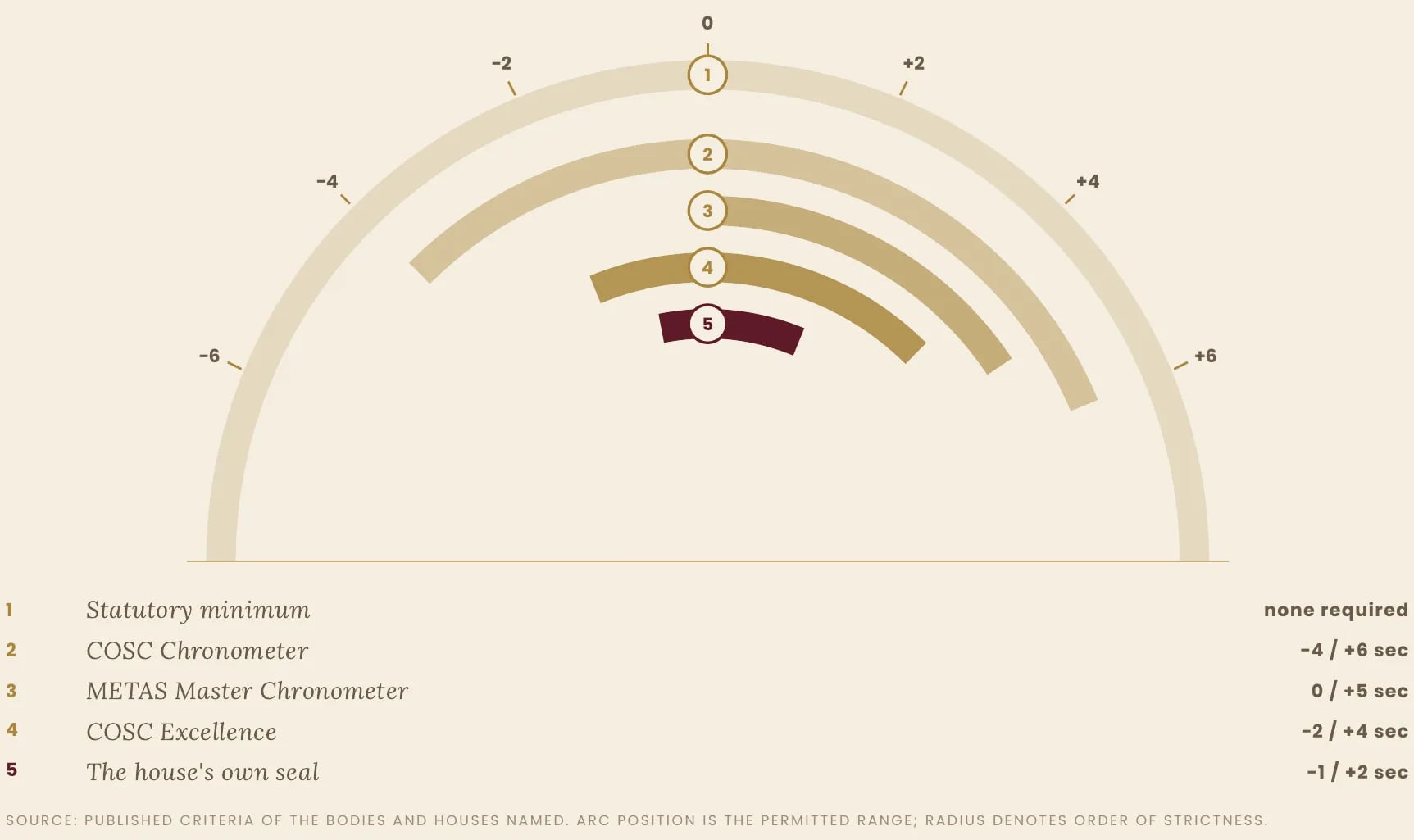
Rule One · Written Before It Is Required
A standard adopted when a regulator demands it is compliance. A standard adopted years earlier is character — and cheaper, because the house that already keeps the records is not rebuilding them under supervision. The House’s governance, risk, due-diligence, onboarding and information-security frameworks exist on this basis: the licence will one day be applied for against records that already exist.
Rule Two · The Enforcer Does Not Profit From Passing
The most easily overlooked feature of the Patek Philippe Seal is not its tolerance. It is that the house created two separate organs to administer it — one to write the rules, one to apply them — independent of each other and overseen by a supervisory body. The Geneva Seal reaches the same end differently: the certifying laboratory audits the houses without warning, several times a year. A standard enforced by the people whose work is judged is not a standard.
Rule Three · Measured on the Finished Object, Not the Part
The most consequential horological reform of recent decades was the shift from certifying the movement to certifying the cased watch. A perfect movement in a poor case keeps poor time, and for a century the seal did not notice. The equivalent is exact: a house that certifies the components it selected has certified nothing. The object of measurement is the working institution, after integration, under load.
What the House Publishes, and What Would Falsify It
A document that spends four sections urging others to publish a tolerance and submit to measurement would be worthless if it published none of its own. The two exhibits below are therefore the operative test of this entire Standard. The first states what the House commits to in figures. The second states what an observer would have to see in order to conclude that the House had failed — because a commitment that cannot be falsified is not a commitment.
Exhibit 12 — The Tolerances of the House
| The figure | How an outsider can observe it | |
|---|---|---|
| Senior response to a trigger event | Within 5 business days | Dated correspondence, by a principal rather than a coordinator |
| Redundancy in any layer whose single failure would be terminal | Minimum 2 executed counterparties | The capability chain register, which names them |
| Reconciliation of an institution under mandate | Daily | The reconciliation record, with monthly written variance explanation |
| Operating runway designed into every capital plan | Minimum 24 months | The capital deployment schedule |
| Contingency reserve held outside all allocated pools | Minimum 10 per cent | The same schedule; untouched through the first phase |
| Disbursement ahead of the deliverable it funds | None | Invoices, each tied to a completed phase gate |
| Design fee creditable against a subsequent mandate | In full | The engagement agreement itself |
| Disclosure of any partner concession or vendor margin | Before signature, in writing | The written disclosure, which exists or does not |
| Right of the principal to approach any counterparty directly | Unconditional | Test it. There is no other verification |
| Retention of engagement records | Indefinite, edition-numbered | Any document of the House, by its reference |
Source: The Standard of the House. Figures are minima held in the absence of any regulatory obligation to hold them, and are stated as at this edition.
The second exhibit is published deliberately and is, in the view of the House, the single most consequential page in this document. Any firm can assert a standard. What distinguishes a standard from a claim is that its breach is visible from outside — that a client, without access to the House’s records, can state in advance what he would have to observe in order to conclude that the standard had not been kept. The list below is that statement, and it is offered as an instrument rather than as a flourish.
Exhibit 13 — What Would Falsify This Standard
Clause · The observation that would disprove it
- 1Architecture before procurementA vendor selected before a written specification the principal owned
- 2Every counterparty namedA counterparty in the chain the principal was not permitted to contact
- 3The specification is never the variableA fee reduction met by a quiet reduction of scope, undocumented
- 4Benches, not departmentsWork released over the objection of the master responsible for it
- 5One codified methodTwo engagements conducted differently with no written revision between them
- 6Designed for the depleted stateA capital plan presented with a runway under twenty-four months
- 7Numbered and retrievableA published standard without an edition number, or a superseded version still in circulation
- 8The obligation runs with the objectA management mandate declined on grounds of size once the institution is running
Two Notes on the List
The clause on codified method is the one an assembling house is most likely to breach, because a second engagement always presents reasons to improvise. The guard is narrow and absolute: a revision must be written before it is applied, never explained after.
The clause on the management mandate is the one a growing house is most likely to breach, because declining a small mandate is commercially rational and doctrinally fatal. The obligation runs with the object, or it is a warranty with a longer name.
A client, counterparty or introducer who observes any of the conditions above is invited to state it in writing to the Office of Institutional Intelligence, citing the reference of this edition. The House will answer in the same form, and both the observation and the answer will be entered in the register. An instrument that is never used is indistinguishable from a claim.
A standard whose breach is invisible from outside is not a standard. It is a preference.
Lesson Eight · Constant Force
A mainspring delivers its greatest torque when fully wound and its least when nearly run down, and a movement’s rate varies with the force reaching the escapement. Horology’s most sophisticated mechanisms exist to solve this one problem: the fusée-and-chain, which changes leverage as the spring unwinds; the remontoire, which re-arms a small secondary spring at fixed intervals; and the tourbillon, patented by Breguet in 1801. These devices do not increase performance. They deliberately sacrifice peak torque in order to make the torque constant.
Exhibit 14 — The Fusée and Chain
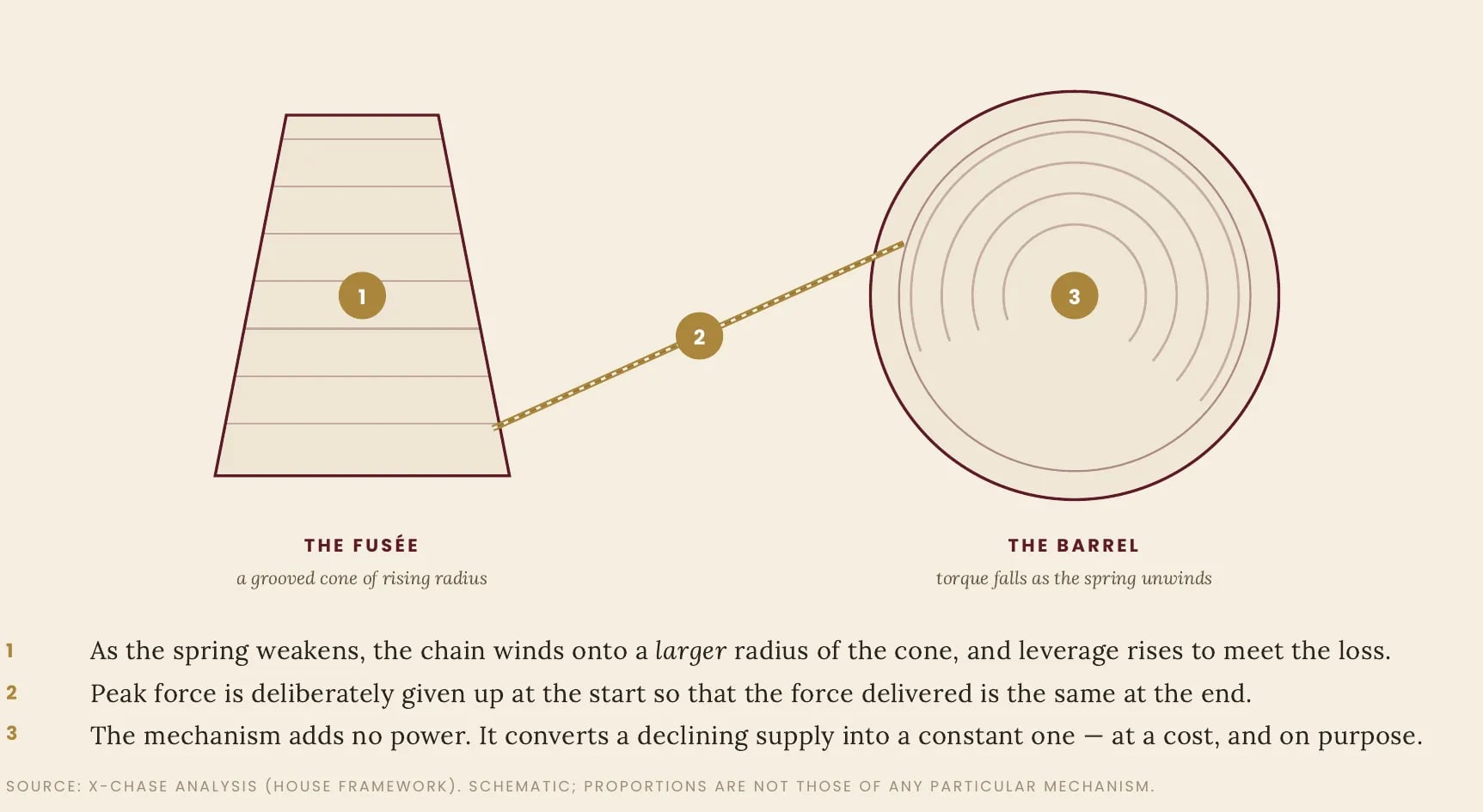
Read the dashed line as the ordinary institution. It launches at maximum force — capital fresh, attention undivided, the founder in every meeting — and its performance is a decaying function of that opening condition. It sits inside the tolerance band for a while and then leaves it, quietly, without a decision being taken.
The gold line is the designed institution. It gives up the launch peak on purpose. It is dimensioned not for its best month but for its twenty-fourth, and every part of it — the runway, the fee structure, the staffing plan, the vendor commitments — is sized against the depleted state rather than the fresh one. The doctrine follows directly: an institution is not designed for the day it opens. It is designed for the day the founder’s attention is elsewhere and the capital is two thirds spent, because that is the day it is actually tested.
The tourbillon is not there to make the watch better. It is there to make the watch the same tomorrow as today. That is the whole of institutional design.
Lesson Nine · The Register, and the Numbered Object
The oldest houses share a habit that looks clerical and is in fact their most valuable asset: they number every object they make and never destroy the register. Vacheron Constantin’s records run from 1755; Patek Philippe’s from 1839, and the house will still, on request, issue an extract from its archives for a watch made a century and a half ago, stating what it was, when it left, and to whom. The commercial consequence is enormous — an object with an unbroken record is worth a multiple of an identical object without one — but the operational consequence came first. You cannot service what you cannot identify.
The House already keeps this practice. Every document it issues carries a reference; the reference encodes the line, the type and the number; nothing is superseded without a new edition number; and the register is maintained not for the client’s benefit but for the House’s, because a standard that cannot be traced backwards cannot be enforced forwards.
Exhibit 15 — Extract From the Archives
Reference XC·FW·ST-01 · Line and type: The Framework · Standard · Edition: First, July 2026 · Entered in the register, retrievable, not superseded. On the bench — and in the House.
- 1A serial number on the movement and on the caseA reference on every document — XC · line · type · number
- 2The register of production, never destroyedThe archive of engagements, studies and decisions
- 3Extract from the archives, issued on requestThe engagement record, with the client’s written consent
- 4The certificate of origin with the objectThe written record of why each provider was selected
- 5Edition and revision marks on a calibreEdition numbering on every published standard
A discipline hidden in the third row deserves naming, because it is the one most firms in our industry fail. A house that intends to publish a record of its work must obtain the right to do so at the time of the engagement, in writing, in the agreement itself. Asked afterwards the answer is usually no, and the archive that would have been the House’s principal asset in year ten does not exist.
Lesson Ten · Service for the Life of the Object
Written into the Patek Philippe Seal, alongside the tolerances, is an undertaking of a different kind: the house will service and restore every watch it has made since 1839, whatever its age. It is not a warranty. A warranty expires and covers defects. This is a standing obligation to keep a mechanism alive indefinitely, which requires the house to maintain tooling, parts and — most difficult of all — the human skill for calibres it stopped producing a century ago. A serviced watch is then held for a further fourteen days of testing before it is returned, and must satisfy the same criteria as a new one.
This is the horological answer to the question every principal asks the House in one form or another: what happens when you leave? The answer the trade gives is that the maker does not leave. The object outlives the transaction, and the maker’s obligation runs with the object.
Exhibit 16 — The Dial of the Mandate
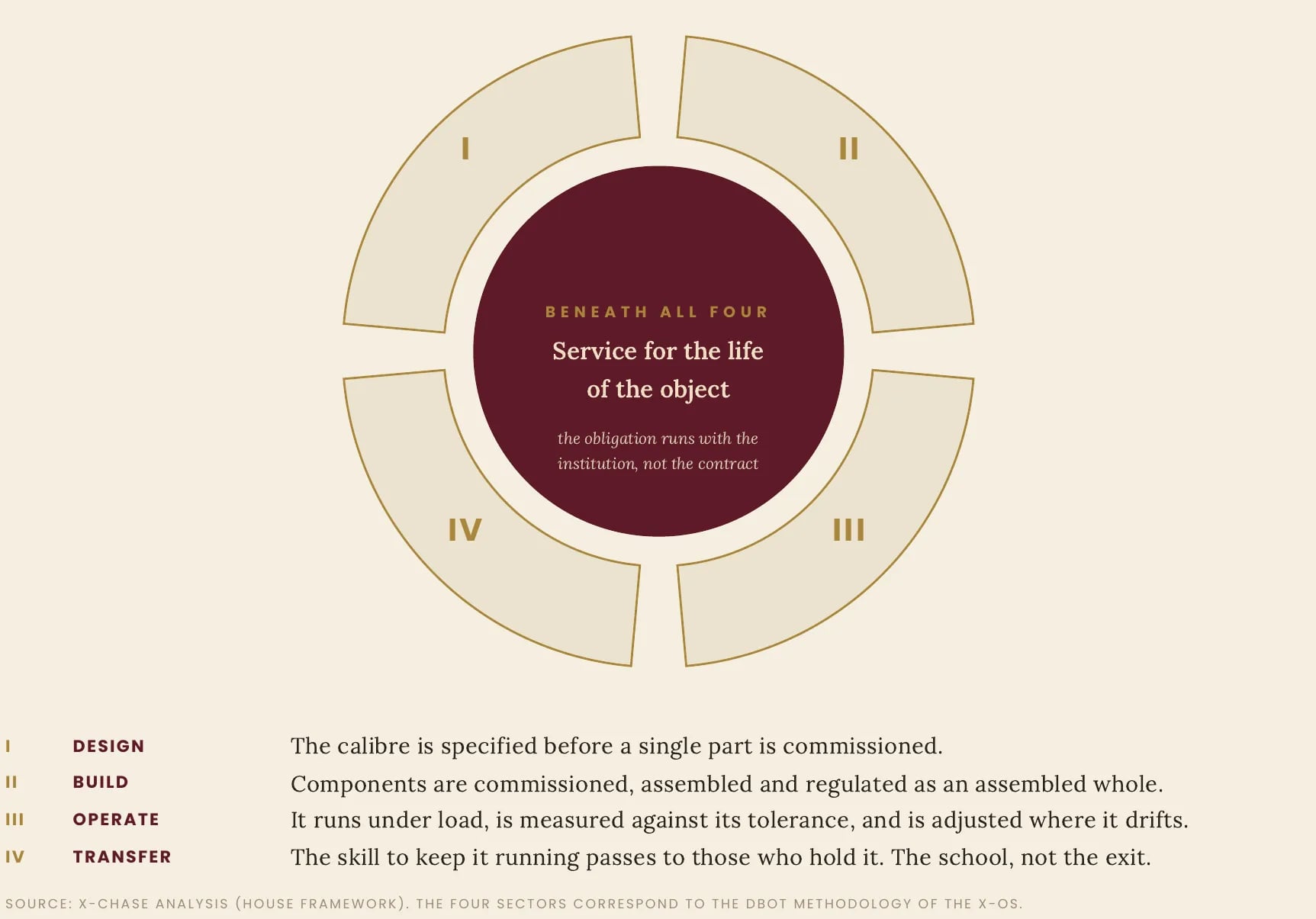
Two clarifications, because both are frequently misread. Transfer is not departure: in horology the master’s obligation to the object does not end when he trains a successor, and in the House the Transfer phase is capability handed to the client’s team, with full handover strictly optional and governed by the agreement. And service is not free. Patek charges for it, at rates reflecting the work; what is unconditional is not the price but the availability. The House holds the same line — the management mandate is priced, and it is offered for as long as the institution exists.
The Twelve Clauses of the Watchmaker’s Standard
What follows is the operative part of this document. Each clause is stated as an obligation of the House rather than as a claim about it, and each is drawn from a lesson set out above.
- 01Architecture before procurementNo component is commissioned before the whole is specified. The design is owned by the principal, in writing, before a vendor is approached.
- 02The House regulates what it did not makeIt manufactures no platform and claims none. Its craft is specification, selection, integration and adjustment — and it answers for the assembled whole.
- 03Every counterparty namedThe capability chain is written, and the principal may approach any counterparty in it directly, without the House present.
- 04The specification is never the variableWhere price must move, scope is restated openly. It is not reduced silently.
- 05Benches, not departmentsEach capability is held by a master who may refuse to release work, and who is not fully a master until his successor is trained.
- 06The invisible surfaces are finishedTermination clauses, reconciliation, data dictionaries, change control, escalation and offboarding are built to the standard of the surfaces that are seen.
- 07A written standard, before it is requiredGovernance, risk, due diligence, onboarding and information security are held to a codified internal standard in advance of any licence obliging it.
- 08The enforcer does not profit from passingWhere judgement can be independent it is made independent, and no bench audits its own release.
- 09Measured on the finished institutionCertification of a selected component certifies nothing. The object of measurement is the working institution, after integration, under load.
- 10Designed for the depleted stateRunway, staffing, fees and commitments are dimensioned for the twenty-fourth month, not the first.
- 11Numbered, recorded, retrievableEvery document carries a reference and an edition. The register is not destroyed, and the right to record is obtained at engagement, not after it.
- 12The obligation runs with the objectTransfer is the school and not the exit. Management is offered for as long as the institution exists, priced, and never conditional on dependency.
Closing · The Position of the House
The vision is stated in one sentence, and it is deliberately unglamorous. X-CHASE intends to be an établisseur of financial institutions, held to a written standard stricter than its regulator will require — because that is the only version of luxury which survives contact with a decade. The other version, the one the market is full of, is cheaper to produce and identical from the outside, and it fails at precisely the moment the owner most needs it not to.
This document is therefore not a description of the House’s aspirations. It is the instrument against which the House expects to be measured, by its clients and by itself, and it carries an edition number so that it can be.
Where a principal wishes to see the method applied rather than described, the House conducts it as a discrete, paid, fixed-scope engagement whose deliverable is an architecture the principal owns and may take elsewhere — the drawing of Lesson Three, before any procurement begins. That engagement is the first tolerance in Exhibit 12 that a client can test for himself.
Standing Disclosure & Disclaimer
X-CHASE is an institutional financial systems firm. It is not a regulated financial institution, bank, broker, asset manager or authorized investment advisor. Named horological houses, certifying bodies and standards are referenced solely to describe established industry practice, on the basis of their public disclosures; no affiliation, partnership, endorsement or commercial relationship is stated or implied. Tolerances and criteria are stated as at the date of publication and should be verified against the current published rules of the body concerned. This document is published by the Office of Institutional Intelligence for informational purposes and does not constitute investment, legal, regulatory or tax advice.