

THE DOCTRINE SERIES · STUDY NO. 06
The Quantitative Broker
The house whose product is a model.
MARKET STRUCTURE · DOCTRINE

STUDY NO. 06
Abstract
Study No. 05 sorted every brokerage structure in existence by two coordinates — distance from Source Liquidity, and origin of profit — and placed one house alone in the top-left corner of the map: the quantitative house, the firm that does not source liquidity because it is the liquidity. That single line is the subject of this study.
The term is used loosely. Any broker with an application programming interface now calls itself quantitative; any broker with a machine-learning vendor calls itself intelligent. The distinction that matters is narrower, and it is testable. A conventional broker earns by intermediating a relationship: it acquires a client, routes his order, and either takes a toll for passing the risk or holds the risk itself. A quantitative broker earns by pricing something the client cannot price for himself — the cost of his own execution, the toxicity of his own flow, or the risk embedded in the order he is about to send. Its inventory is not liquidity. Its inventory is measurement.
That difference is not cosmetic, and it propagates through every part of the institution. The front office becomes a research department with a sales desk attached rather than a sales desk with a dealer attached. The back office becomes a data function operating in real time rather than an administrative function operating overnight. The client changes: the retail speculator disappears from the book entirely and is replaced by a counterparty with a fiduciary obligation to prove that his execution was reasonable. The economics invert: cost becomes fixed and front-loaded, the marginal cost of the next client falls towards zero, and the firm therefore has a break-even cliff rather than a margin ramp. And artificial intelligence ceases to be an ornament bolted to the marketing and becomes the substance of the product — which is precisely why its governance, rather than its accuracy, is now the binding constraint.
Sections I and II define and classify. Sections III and IV set out the architecture, front and back. Section V prices the model. Section VI identifies who actually pays. Section VII assesses artificial intelligence and the direction of travel. Section VIII profiles five houses. Section IX sets out how one is built, and what it costs before it earns.
Definition · The Three Tests
The pricing test — does the firm quote, schedule or margin from a model it owns, or does it pass through a decision generated by someone else’s?
The measurement test — can the firm demonstrate, from its own records and against a stated benchmark, what its execution cost the client?
The marginal cost test — does the ten-thousandth client cost what the first thousand cost, or has the cost of service fallen to nearly nothing?
A house that fails the first two tests is a distribution business with quantitative decoration. There are a great many of them, and they are not the subject of this study.
Exhibit · The Course of the Study
- IThe Line, And What Sits On Either Side Of ItPart One · Definition
- IIFive Species Of Quantitative HousePart One · Definition
- IIIThe Front Office Is A Research DepartmentPart Two · Architecture
- IVThe Back Office Runs In Real Time Or It Does Not RunPart Two · Architecture
- VFive Revenue Lines, And Only Three Survive A TroughPart Three · Economics
- VIThe Client Is Whoever Must Prove He Was ReasonablePart Three · Economics
- VIIArtificial Intelligence, And Where The Market Is GoingPart Four · Machine And Direction
- VIIIFive Houses, One Per SpeciesPart Four · Machine And Direction
- IXHow One Is Built, And What It Costs Before It EarnsPart Five · Construction
The Line, And What Sits On Either Side Of It
The useful way to establish what a quantitative broker is, is to establish what it is not. It is not a broker with an API; the API is a delivery mechanism and every broker now has one. It is not a broker with algorithms, because a broker may license a third party’s algorithms and remain a distributor. It is not a proprietary trading firm, because a proprietary firm has no clients and therefore no obligation to explain its pricing to anyone. And it is not, in the ordinary case, a firm that has purchased an artificial-intelligence module and placed it in a pitch deck.
What defines it is ownership of a decision. Somewhere in the transaction a question arises that has a quantitative answer — at what price should this be quoted, over what horizon should this order be worked, how much margin does this portfolio actually require — and the quantitative broker answers it with a model it built, tested and can defend. Everything else in the firm exists to feed that model, deliver its output, and prove afterwards that the output was good.
Exhibit 1 — The Two Houses Compared
| The conventional house | The quantitative house | |
|---|---|---|
| Product | Access to a market, and a relationship | A priced decision, and the evidence that it was correct |
| Inventory | Liquidity obtained from a provider | Data, and models built upon it |
| Source of edge | Distribution, brand, service, credit terms | Measurement the client cannot reproduce |
| Cost structure | Variable — acquisition cost per client | Fixed and front-loaded — research, data, connectivity |
| Scarce resource | Clients | Researchers, and clean historical data |
| What the client buys | Ability to transact | A lower cost of transacting, demonstrated |
| Sales cycle | Marketing, then onboarding | Technical evaluation, then procurement |
| Characteristic death | Client acquisition cost exceeds client value | Fixed cost is never covered by volume |
Source: X-CHASE analysis (House Framework). Planes follow the structure established in Study No. 05.
Every broker is measured. The quantitative broker is the one that does the measuring — and sells the measurement back.
One consequence deserves stating at the outset, because it governs Section IX. The conventional house can be assembled from vendors: a licence, a platform, a liquidity feed, a customer-relationship system, a payment provider. Ninety days is a realistic timetable and the components are all purchasable. The quantitative house cannot be assembled this way at all, because the single component that constitutes it — a proprietary, tested, defensible model, and the data history required to have tested it — is the one thing no vendor sells.
Five Species Of Quantitative House
The category is not one business but five, differing in origin of profit, in client, and in the minimum scale below which the structure does not function.
I · The Agency Algorithm House
Sells execution algorithms and transaction-cost analytics on a strictly agency basis, and never takes the other side of the client’s order. Its neutrality is not a compliance posture; it is the product, and it is why a bank desk will route through it. Revenue is commission per contract, plus a recurring analytics subscription.
II · The Internalising Market Maker
Quotes both sides continuously, holds inventory, and earns the capture. It is the most profitable species and the most heavily legislated, and its conflict is structural, disclosed, and managed by governance rather than eliminated by design.
III · The Automated Multi-Asset Broker
An execution and custody utility whose quantitative character lies in automating its own operations rather than in pricing the market. It competes on cost per trade, and much of its profit is net interest and securities lending rather than commission.
IV · The Quantitative Prime
Extends financing, clearing and custody on a real-time risk engine rather than an overnight batch, pricing margin as a function of measured portfolio risk rather than of a schedule. It is a lender before it is a broker.
V · The Quantitative Prime-Of-Prime
A market maker that also distributes: it prices its own streams to brokers, funds and proprietary desks, and sells the bridge, routing and risk analytics alongside the liquidity. It is simultaneously counterparty and supplier of the tools by which it is measured.
Exhibit 2 — The Map Of The Category
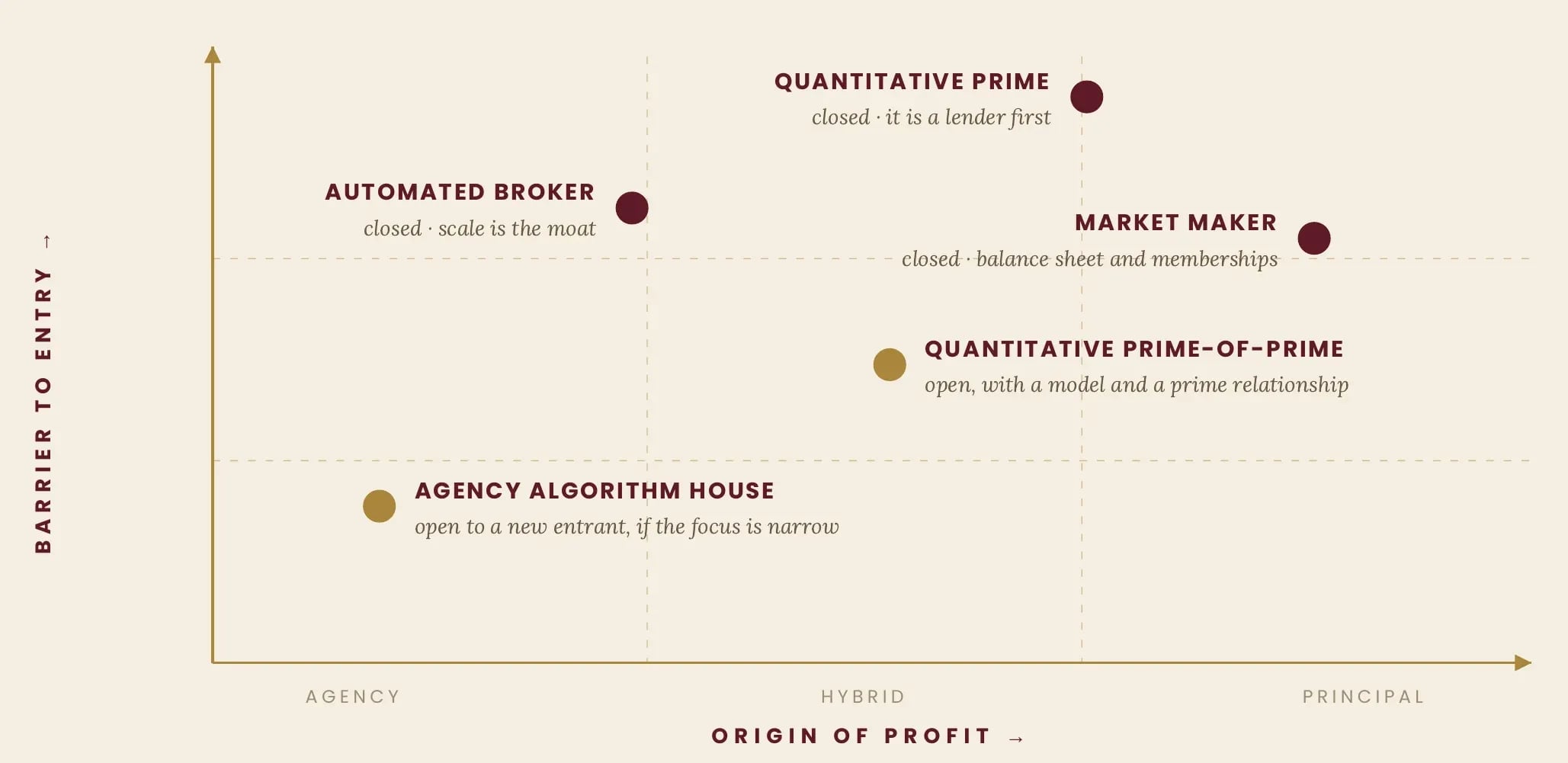
Source: X-CHASE analysis. Gold denotes a structure open to a new entrant; burgundy, one that is not. Positions are structural.
Exhibit 3 — The Five Species Compared
| What it sells · Origin of profit | Principal client · Open to a new entrant | |
|---|---|---|
| Agency algorithm | Execution schedules and cost analytics · Agency commission | Funds, pensions, bank desks · Yes — narrow focus only |
| Market maker | A two-sided quote · Principal capture | Venues, brokers, retail flow · No |
| Automated broker | Cheap, reliable market access · Commission plus net interest | Everyone, at scale · No |
| Quantitative prime | Financing, clearing, custody · Financing spread | Funds and proprietary firms · No |
| Quantitative prime-of-prime | Liquidity plus infrastructure · Mark-up plus technology fee | Brokers, funds, family offices · Yes — with a model and a prime |
Source: X-CHASE analysis (House Framework). Accessibility is assessed against capital and permission, not technical difficulty.
The last column is the operative one, and it is where most feasibility work should begin rather than end. Species two, three and four are effectively closed to a new entrant. Each requires either memberships and counterparty relationships that are earned rather than purchased, or a scale that cannot be reached from a standing start, or a balance sheet whose cost of funds is a competitive variable in its own right. A principal entering this domain today is therefore choosing between species one and species five — and species one only where the asset class is narrow enough for a small research team to be genuinely better than the incumbents at one measurable thing.
The question is never whether the firm can build a model. It is whether the species it has chosen will accept a firm that has no history.
There is a second reading of the same exhibit that matters more commercially. Notice that the two accessible species sit at opposite ends of the conflict spectrum. The agency house sells neutrality and can therefore serve bank and proprietary desks who would never route through a counterparty that can see their flow. The prime-of-prime sells liquidity and infrastructure and cannot claim neutrality at all, but earns from three sides rather than one. These are not two versions of the same business at different sizes. They recruit different people, they are sold to different buyers, they are licensed under different permissions, and a house cannot credibly present itself as both to the same client.
That decision — which of the two, and on which asset class — is the whole of Phase 0 in Section IX. It is made once, it determines every subsequent choice of vendor, jurisdiction, and hire, and it is the decision most frequently deferred by principals who mistake it for a marketing question.
The Front Office Is A Research Department
In a conventional brokerage the front office is the revenue-producing organ: sales, dealing, retention. In a quantitative house the revenue-producing organ is research, and the commercial function exists to distribute what research produces. This is an organisational fact before it is a technical one, and it is where most conversions fail — a firm that adds a data scientist to a sales-led business has not changed species.
Exhibit 4 — The Front-Office Stack
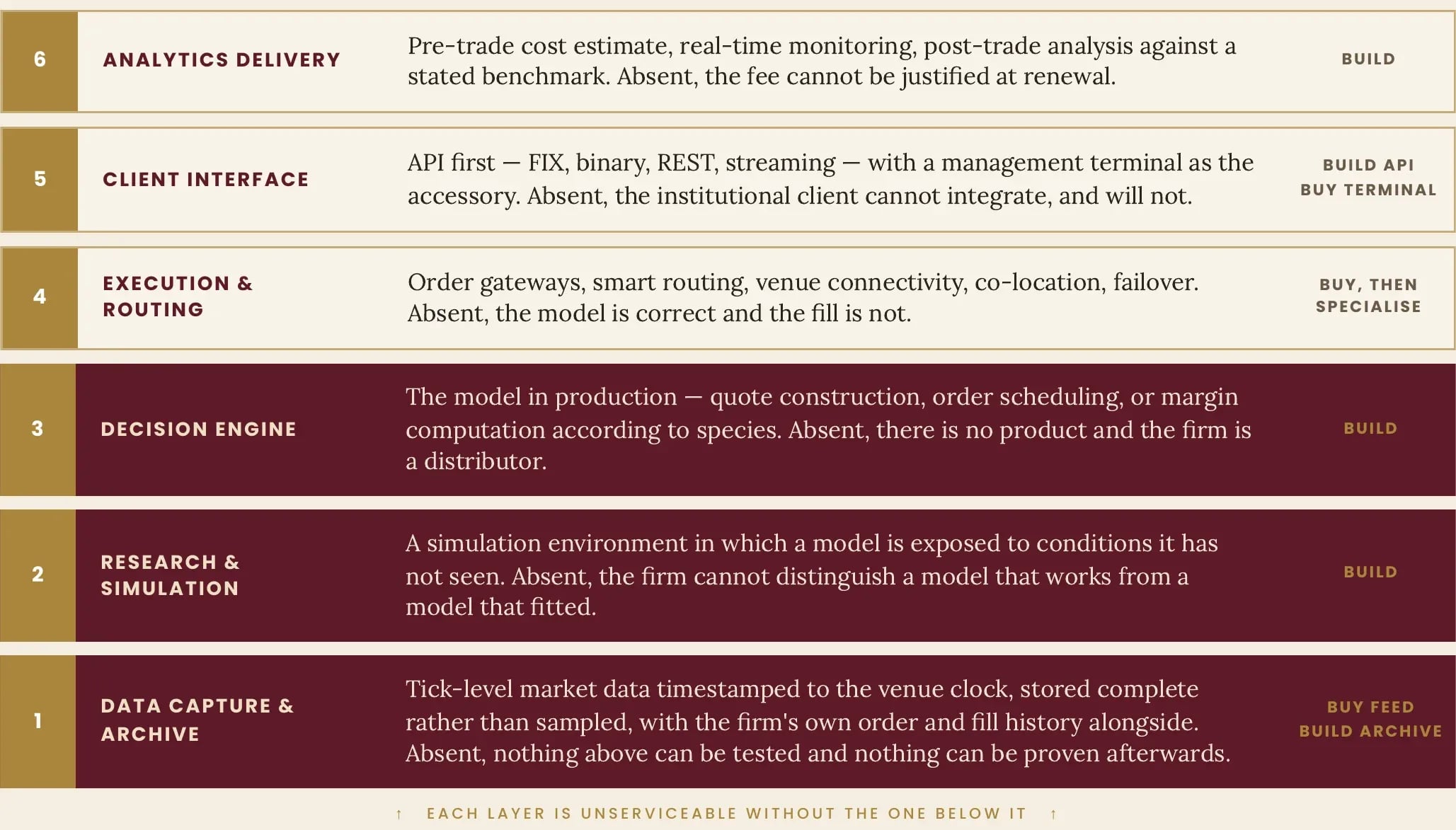
Source: X-CHASE analysis (House Framework). Burgundy layers are proprietary by necessity; the remainder may be procured.
In a conventional broker the sales desk carries the firm. In a quantitative broker the data capture does — and it is the line item most often cut first.
The six layers describe what must exist. They do not describe how the firm improves, and improvement is the only durable defence in this business — a model that is not being refined is depreciating against the market it prices. The mechanism of improvement is a closed loop, and the loop is what a principal is actually funding.
Exhibit 5 — The Measurement Loop
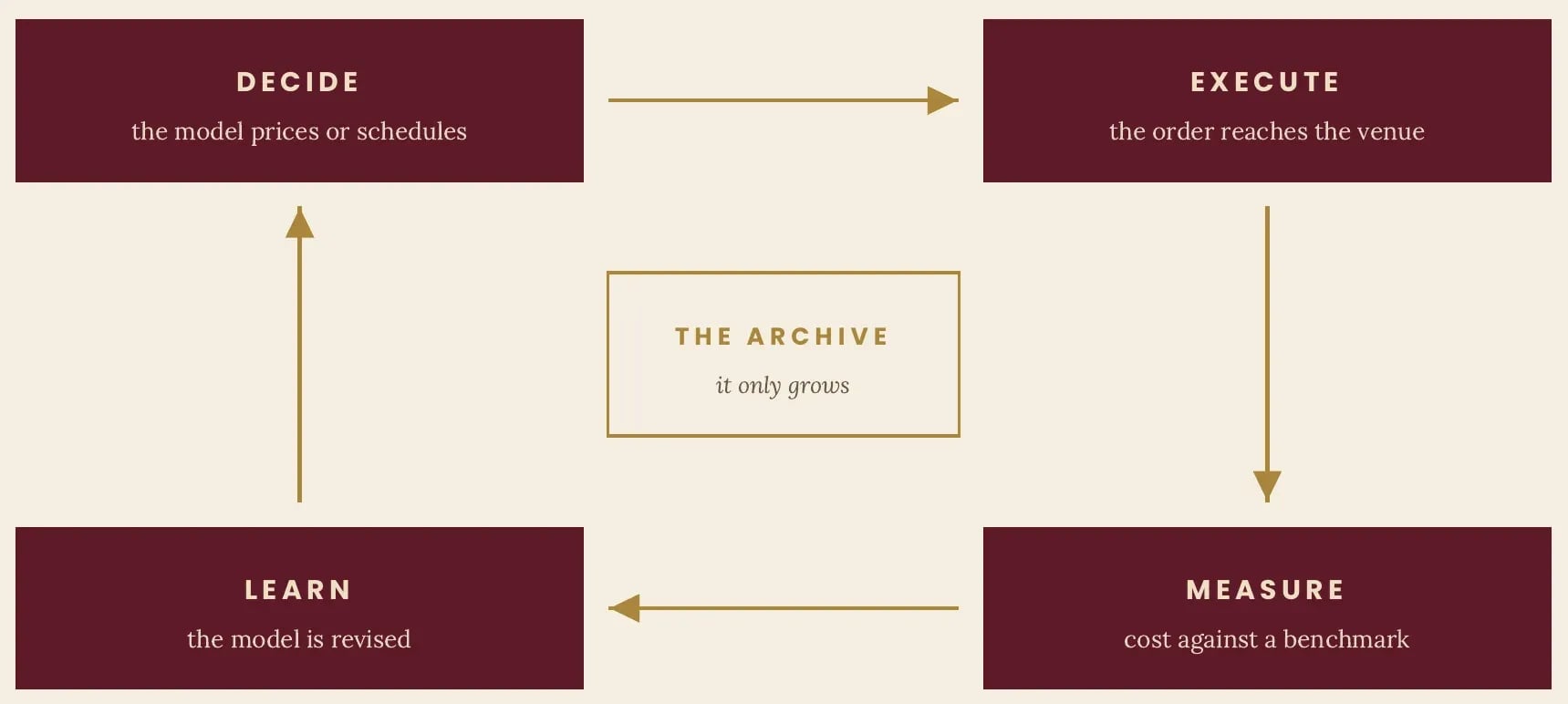
Source: X-CHASE analysis (House Framework). Where the loop breaks: measurement is not retained, or is retained but never returned to research.
Two remarks on the measurement step, because it is habitually mistaken for marketing collateral. First, the post-trade report is the invoice justification: an institutional client renews on evidence, not on relationship, and a house that cannot produce the evidence is repriced at every review. Second, the same apparatus that proves the result to the client is the apparatus that proves best execution to the regulator. Built once, it serves both; a firm that treats it as a brochure will build it twice, and the second time under supervision.
The loop also explains why an incumbent with ten years of archive is difficult to displace, and why the correct opening move for a new house is a narrow one. A firm cannot out-archive a competitor across every instrument. It can accumulate more measured history than anyone else in one contract, one venue, one order type — and that is a defensible position from which the archive can be widened later.
The Back Office Runs In Real Time Or It Does Not Run
The back office of a conventional brokerage is a reconciliation function that closes overnight and is permitted to be a day behind. In a quantitative house that latency is not an inefficiency; it is an unpriced risk. If positions, exposures and margin are known only at the following morning’s batch, then for the whole of the trading day the firm is operating on an estimate of its own solvency.
The second structural difference is evidentiary. The supervisory question has moved. A regulator examining an algorithmic firm no longer asks principally whether the algorithm was profitable; it asks who authorised its release, what was tested before release, what changed since, who may switch it off, how quickly, and whether any of that can be evidenced from records rather than from recollection. A quantitative broker without a documented model-governance file is not merely an unsophisticated firm. It is an unlicensable one.
Exhibit 6 — The Operating Ledger
| What it actually governs · Real time | The evidence that will be asked for | |
|---|---|---|
| Pre-trade risk & limits | Real time: yes. Whether an erroneous or oversized order can reach a venue at all | Limit configuration history and rejected-order log |
| Position & P&L | Real time: yes. Whether the firm knows its own exposure during the session | Intraday reconciliation records and break register |
| Margin & collateral | Real time: yes. Client leverage, and the firm’s own liquidity under stress | Margin model documentation and stress results |
| Clearing & settlement | Real time: no. Whether trades complete, and at what operational cost | Clearing terms, fails and ageing reports |
| Client money | Daily. The firm’s licence, more directly than anything else on this ledger | Daily reconciliation, bank confirmations, attestations |
| Model governance | On change. Whether the firm may deploy a model at all | Approval file, test evidence, change log, kill-switch procedure |
| Transaction reporting | Prescribed. Regulatory standing, and the cost of remediating errors | Submission records, rejection rates, corrections |
| Surveillance | Real time: yes. Whether abuse patterns are detected by the firm or by the regulator | Alert log, disposition rationale, escalation records |
| Audit trail | Real time: yes. Everything above; without it none of the above is provable | Immutable, synchronised, time-stamped logs |
Source: X-CHASE analysis (House Framework). Requirements vary by jurisdiction and permission; readers must verify against the current rules of the relevant authority.
The commercial reading of that ledger is straightforward. In a conventional brokerage the back office is a cost centre to be minimised. In a quantitative house it is part of the product, because the client is buying provable execution and the proof is manufactured here. The same records that satisfy the supervisor are the records that win the mandate — which is why, in this structure alone, compliance expenditure is properly accounted for as sales expenditure.
Five Revenue Lines, And Only Three Survive A Trough
A quantitative broker earns from five lines, and the distinction between them is the whole of its strategy. Two are transactional, cyclical and under permanent compression. Three are recurring, contracted and durable. Every quantitative house that has survived a full cycle has deliberately migrated its revenue from the first group towards the second, and every one that has failed did so while still dependent on the first.
Exhibit 7 — The Revenue Architecture
| Basis · Behaviour through a cycle | Durability | |
|---|---|---|
| Agency commission | Per contract, share or lot executed — falls with volume; priced against competitors continuously | Low |
| Principal capture | Spread earned on inventory held — rises with volatility, collapses in calm markets | Low |
| Financing & interest | Margin balances, stock loan, cash — follows the rate environment, not the market | High |
| Data & analytics | Recurring subscription per seat or per firm — largely insensitive to volume; renews annually | High |
| Technology & infrastructure | Licence, connectivity, hosted risk tooling — contracted; embeds the firm in the client’s operations | Very high |
Source: X-CHASE analysis (House Framework). Durability is assessed as persistence of revenue through a volume and volatility trough.
The cost side inverts the conventional picture. The dominant costs of a quantitative house — research salaries, market-data licences, co-location and cross-connects, clearing membership, compliance and model governance — are fixed, incurred before the first client, and largely insensitive to how many clients follow. The marginal cost of serving the next client, once the platform exists, is close to zero.
That single fact determines the shape of the business, and it is not the shape most business plans assume. There is no gentle ramp of improving margins. There is a volume threshold below which the firm loses money with complete reliability and above which it is exceptionally profitable, and the distance between those two states is short. The exhibit below states it as plainly as it can be stated.
Exhibit 8 — The Break-Even Cliff
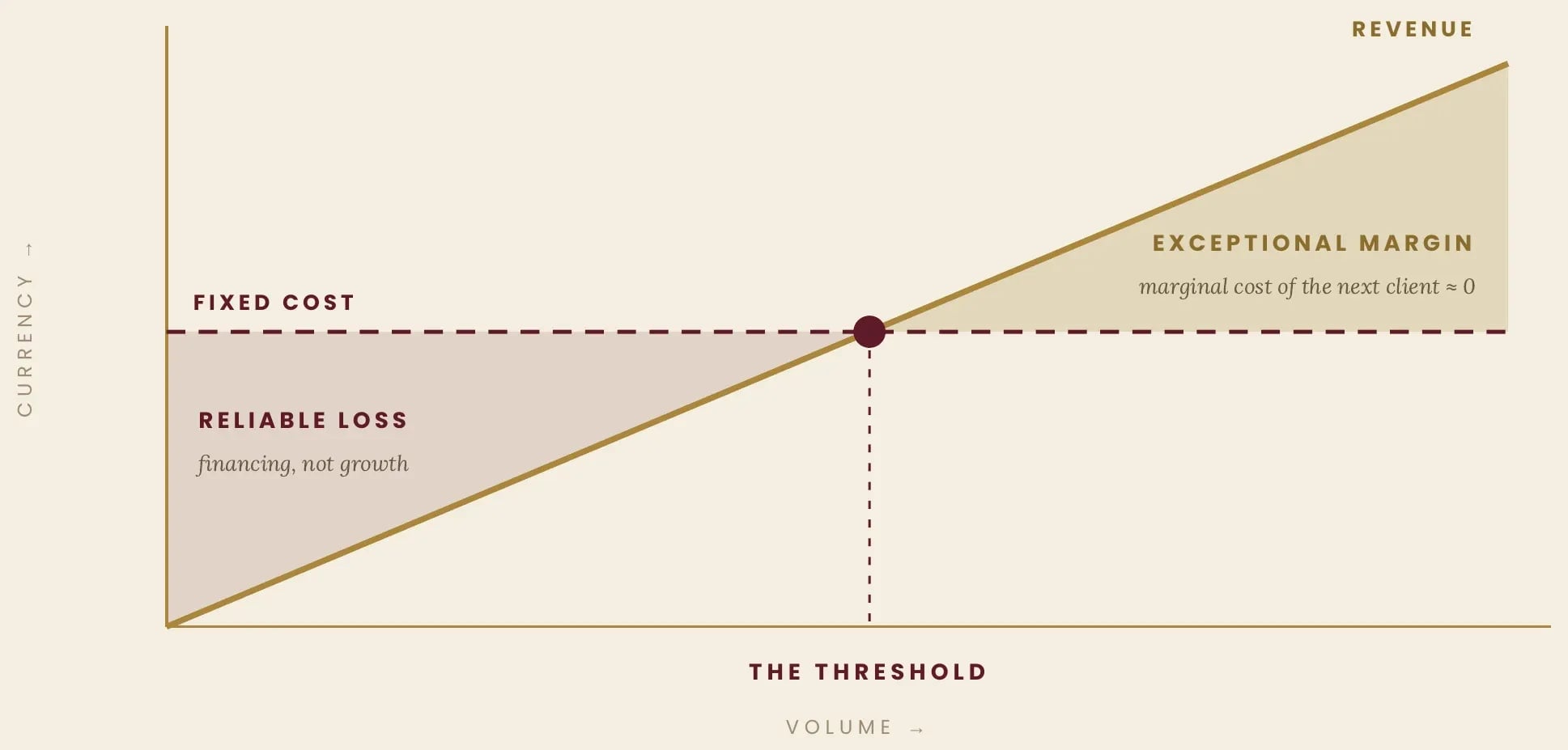
Source: X-CHASE analysis (House Framework). Fixed cost comprises research compensation, market data, connectivity, clearing and compliance. Illustrative shape, not a forecast; axes are unscaled.
A quantitative broker has exactly one number: the volume at which its fixed cost is covered. Everything before that number is financing, and calling it a growth phase does not change what it is.
Two corollaries follow, and both are usually learned late. First, pricing cannot be used to buy the threshold. Discounting a transactional line to win volume moves the threshold further away rather than nearer, because the fixed cost is unchanged and each unit now contributes less towards it. This is the opposite of the retail intuition, where lower pricing buys share that can later be repriced.
Second, the recurring lines are worth disproportionately more than their revenue suggests, because they arrive whether the market trades or not. Their function is not margin; it is the lowering of the threshold itself. A subscription that covers a quarter of the fixed cost has reduced the volume the firm must win by a quarter — which is why the analytics line that looks like an afterthought at launch is frequently the reason the firm is still solvent at the trough.
The practical instruction that follows is uncomfortable but simple. The plan should be written in volume rather than in months, the fixed cost should be stated as a single figure that everyone in the firm knows, and the financing should be raised for the distance to the threshold plus a margin for the fact that it will be reached later than forecast.
The Client Is Whoever Must Prove He Was Reasonable
The demand curve for quantitative brokerage is not built from an appetite for sophistication. It is built from obligation. Somebody, somewhere in the client’s institution, is required to demonstrate to a board, an investor, a trustee or a supervisor that the way an order was executed was reasonable and that its cost was measured. That requirement is what creates a buyer for measurement, and it is why the retail speculator — who is accountable to nobody — never appears in this book.
Exhibit 9 — The Demand Map
| What he is actually buying | What he will not pay for · How he is won | |
|---|---|---|
| Systematic funds & CTAs | Slippage reduction expressed in basis points, and a simulation environment he trusts | Will not pay for: relationship, hospitality, research he does not use. Won by: a measured trial against his incumbent. |
| Discretionary managers & pensions | Defensible best execution and reporting that survives an audit | Will not pay for: latency he cannot use. Won by: a consultant introduction, then evaluation. |
| Bank & dealer desks | Algorithms they choose not to build, from a counterparty that does not compete with them | Will not pay for: any arrangement in which the provider sees and can trade their flow. Won by: demonstrated neutrality. |
| Proprietary firms | Market access, credit, and latency at a known cost | Will not pay for: advice of any kind. Won by: a technical benchmark. |
| Downstream brokers | Liquidity, bridge, and the risk analytics to run their own book | Will not pay for: anything that reprices without notice. Won by: a reference from a peer broker. |
| Family offices & private capital | Institutional execution and custody they cannot reach directly | Will not pay for: complexity they must staff. Won by: an introduction, then governance review. |
Source: X-CHASE analysis (House Framework). Client categories are structural and not mutually exclusive.
Three commercial consequences follow, and they are the reason a retail playbook fails completely here.
The sale is an evaluation, not a campaign. This client does not respond to positioning; he runs a controlled comparison against his existing provider, using his own transaction-cost analysis, over weeks, on real orders. Marketing spend does not shorten it. The only accelerant is a credible reference from a peer institution, which is why the first three clients are worth several times their revenue.
Neutrality is a priced asset. Where the client is himself a trading firm, whether the provider can see and act upon his flow is not a matter of etiquette; it determines whether he can use the provider at all. A house intending to serve bank and proprietary desks must decide early that it will not internalise, and must then be able to prove it.
Obligation, not appetite, sets the size of the market. As reporting and best-execution duties widen across jurisdictions, the population of institutions that must buy measurement grows independently of whether markets are rising. This is the most durable feature of demand for this structure, and the reason the segment expands in bad years.
Artificial Intelligence, And Where The Market Is Going
Artificial intelligence occupies a peculiar position in this industry: it is simultaneously overstated in the marketing and understated in the accounts. Overstated, because the phrase is applied to statistical techniques that predate it by decades. Understated, because its largest present contribution is not in the pricing model at all but in the operating cost of the institution.
Exhibit 10 — Artificial Intelligence In The Stack
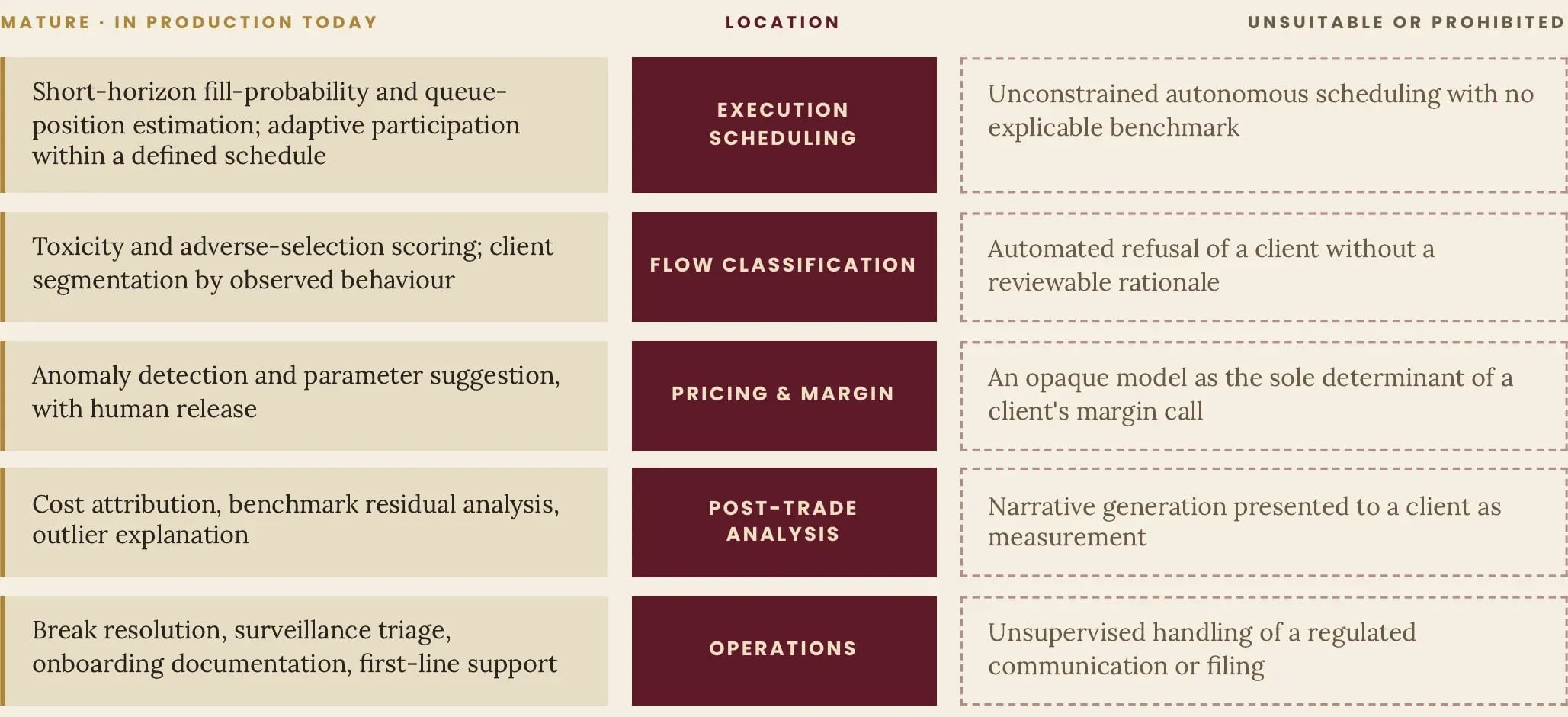
Source: X-CHASE analysis (House Framework). Assessment is of structural suitability under supervision and client-disclosure obligations, not of technical capability.
A model that cannot be explained cannot be licensed. In this industry interpretability is not a scientific preference; it is a permission.
The Direction Of Travel
Execution becomes a measured commodity. As measurement becomes standard, the premium migrates away from access — already free at the margin — and towards evidence. The firm that can prove its result is paid for the proof.
The boundary between broker and technology firm dissolves. The surviving intermediaries of the next decade are technology firms holding regulatory permissions, and their competitors are not other brokers but the infrastructure providers moving up the chain towards the client.
Supervision shifts from conduct to model governance. The question moves from how the client was treated to how the model was approved, tested, changed and stopped. Firms that treated documentation as overhead will find it was the licence.
Compression continues on transactions and halts on data and financing. Transactional lines converge towards a marginal cost of nearly nothing. Recurring revenue does not compress the same way, because it is not comparable across providers.
The displaced firm of this decade is the mid-sized conventional broker. Too large to be a niche and too small to automate to the level of the utilities, holding neither a model nor a balance sheet. It is not competed away by a better broker; it is compressed out by the disappearance of the value it used to add.
Five Houses, One Per Species
The five firms below are selected not because they are the largest but because each is the clearest available instance of one species, and each teaches something a founder needs. All are described from their own public disclosures.
Quantitative Brokers · New York · Species I
Founded in 2008 by Robert Almgren and Christian Hauff. Almgren, with Neil Chriss, wrote the 2000 paper on optimal execution of portfolio transactions on which the arrival-price algorithm rests; he remains Chief Scientist. The firm sells agency execution algorithms and pre- and post-trade analytics in futures, options and interest-rate markets, and is deliberately broker- and venue-agnostic — a neutrality it treats as the product rather than as a constraint. Deutsche Börse acquired a majority position in December 2020, the founders retaining significant shareholdings and their roles. Offices in New York, London, Sydney and Chennai. The lesson: a research reputation is a distribution asset, and neutrality can be sold.
Virtu Financial · New York · Species II And I
Founded 2008, listed 2015. It acquired KCG in 2017 and Investment Technology Group in 2019, and now reports two segments: Market Making and Execution Services. It makes markets in more than twenty-five thousand securities across some two hundred and thirty-five venues in thirty-six countries, and simultaneously sells the agency toolkit — the Triton execution management system, the POSIT crossing venues, the ITG Net connectivity layer reaching several hundred brokers, and transaction-cost analytics. The lesson: the most profitable species bought its way into the least conflicted one, deliberately, to reduce its dependence on principal risk.
Interactive Brokers · Greenwich · Species III
The automation case, and the oldest of the five. A global multi-asset execution and custody utility whose competitive position is cost per trade and whose profitability rests substantially on net interest and securities lending rather than on commission. Its instructive quality is not its technology but its cost discipline: it has competed for four decades by being cheaper to operate than its rivals, and has never treated that as a completed project. The lesson: at sufficient scale, operational automation is itself a quantitative strategy.
Clear Street · New York · Species IV
Founded 2018. A non-bank prime broker built on a single real-time cloud-native ledger in place of the batch systems of the incumbents. It reported revenue of $783.7m for the nine months to 30 September 2025, growth of 160 per cent year on year, net income of $157.2m, more than two thousand clients and approximately $31.3bn of daily trading activity. It filed to list on Nasdaq in January 2026, reduced the size of its offering by roughly two thirds in February, and then withdrew the registration. The lesson, and it is a sharp one: quantitative infrastructure and a quantitative valuation are different things, and public markets will separate them.
iSAM Securities · London · Species V
The execution and market-making arm of the iSAM group, whose asset-management side is a systematic manager of roughly five billion dollars. Regulated by the FCA, the SFC and the CFTC and CIMA-registered, it operates as an electronic market maker and prime-of-prime across foreign exchange, precious metals and indices, and sells its own infrastructure — a multi-asset bridge and real-time risk analytics — alongside the liquidity. The lesson: the pricing capability was built for the fund first and the brokerage second, which is exactly why it prices better than a distribution-led competitor can.
Named firms are referenced solely as market participants for the purpose of describing industry structure, on the basis of their public disclosures. No affiliation, partnership, endorsement or commercial relationship is stated or implied. Figures are as at the date of publication.
How One Is Built, And What It Costs Before It Earns
The sequence below is a set of gates rather than a project plan. The characteristic failure of this structure is a principal who funds phase three while phase one remains incomplete.
Exhibit 11 — The Build Sequence
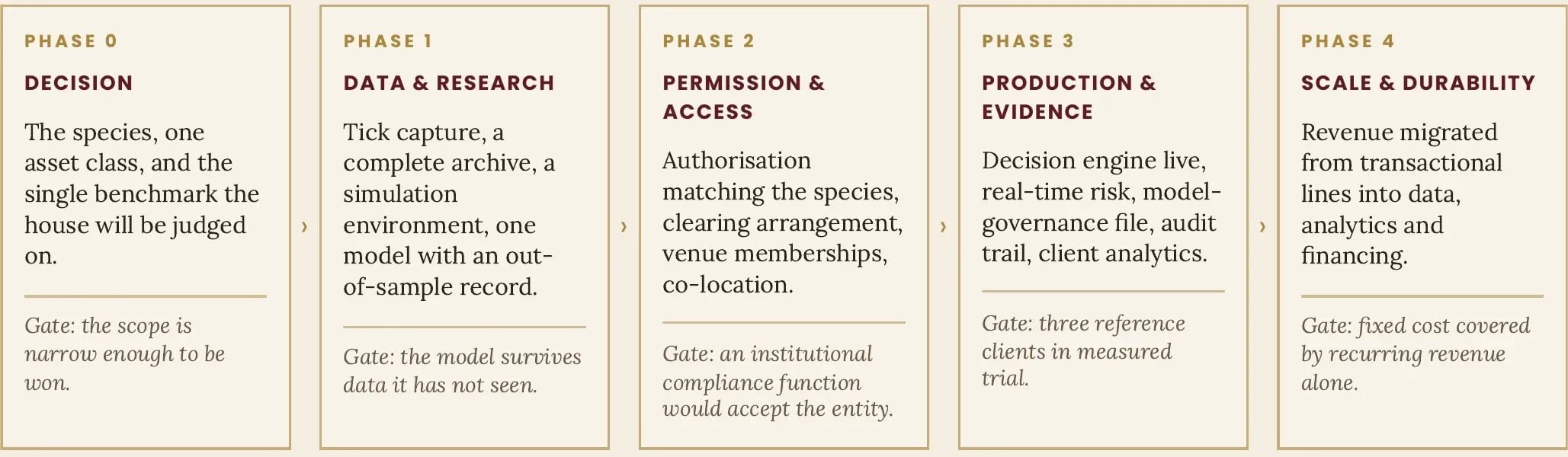
Source: X-CHASE analysis (House Framework). Elapsed time is omitted: these are gates on evidence, not on calendar.
On capital the House states the position plainly. This structure cannot be entered on a retail brokerage’s budget. A credible narrow-focus agency house is a seven-figure undertaking before it earns anything material, dominated by research compensation and data licensing rather than technology purchase, and its break-even is a volume figure rather than a date. A principal with an adequate model and inadequate financing reaches phase three and discontinues in the month before the threshold.
Closing · The Position Of The House
Study No. 05 argued that structure is chosen once and is very nearly irreversible. This study argues something narrower. Of every house in that taxonomy, the quantitative house is the only one that cannot be assembled from vendors. The others can be bought: a licence, a platform, a liquidity feed, a bridge, a payments arrangement. This one cannot, because the component that constitutes it — a proprietary, tested, explicable answer to a question the client cannot answer for himself, with the data history required to have tested it — is the one component no vendor sells. That is the whole of the barrier, and why the position holds once taken.
X-CHASE designs, launches and manages financial institutions. It does not sell technology and holds no economic interest in which vendors a principal selects. Its function here is singular: to establish, before capital is committed, whether what is being built is a quantitative house or a distribution business with quantitative decoration — and to say which, in writing, while the choice is free.
Standing Disclosure & Disclaimer
X-CHASE is an institutional financial systems firm. It is not a regulated financial institution, bank, broker, asset manager or authorized investment advisor. This study is published by the Office of Institutional Intelligence for informational purposes and does not constitute investment, legal, regulatory or tax advice, nor a recommendation to enter into any transaction or to establish any business. Figures and firm descriptions are stated as at the date of publication and drawn from public disclosures. Readers must verify all regulatory requirements against the current rules of the relevant authority and take independent advice before acting.