

THE DOCTRINE SERIES · STUDY NO. 02
The Philosophy of Leverage
On borrowed force in financial markets — its origins, its plumbing, its tiers, its governance, and the single duality, of creation and of ruin, that it carries through every level of the system.
ARCHITECTURE · DOCTRINE

STUDY NO. 02
Abstract
Every position in a modern market is, in some measure, a claim on capital the holder does not own. Leverage is the name for that borrowed force — the device by which a unit of equity is made to command a far larger notional, and by which the system carries far more risk than it holds capital against. It is neither vice nor virtue but a multiplier, and a multiplier is indifferent to the sign of what it multiplies. In calm it deepens markets, tightens spreads, and allocates capital efficiently; in stress it transmits a single failure, instantly, through every party it has quietly connected.
Three facts now govern the subject, where earlier treatments allowed for one. Leverage is manufactured — built tier by tier through repo desks, prime brokers, clearing houses, and the standard contracts that bind them — so that no one creates it alone and no one controls it entirely. Leverage is conditional — the same notional that looks safe at low volatility becomes a margin call at high volatility, because the rules that size it are themselves procyclical. And leverage is unevenly held — its price, its terms, and its very definition change at every tier of the institutional hierarchy, from the central bank that issues the reserve currency down to the retail account that borrows against a deposit.
What follows reads leverage as architecture rather than as a number: where it comes from, how it is built, how it is distributed across the institutional ladder, how it is engineered against failure, how the regulator answers it, how the strongest institutions turn its discipline into an advantage, and why the whole subject lies in the distance between a system that distributes force beautifully in calm and one that survives the moment the calm ends.
Definition · The Two Faces
Leverage is the use of borrowed capital, or of contracts that economize on capital, to command exposure greater than one’s equity. Embedded leverage is the same magnification achieved without an explicit loan — inside a swap, an option, or a structured note — where only a margin is posted and the full notional is controlled. The first is visible on a balance sheet; the second does the most damage, precisely because it is not.
Leverage is borrowed force, neutral in itself. The advantage belongs to those who build for the storm while trading in the calm.
Exhibit · The Course of the Study
- IThe Nature of Borrowed Force
- IIThe Origins — From the Gold Anchor to the Fiat Order
- IIIThe Theoretical Foundations
- IVThe Infrastructure of Credit
- VLeverage Across the Institutional Tiers
- VI · VIIDynamic Risk Engineering & Transmission Through Microstructure
- VIIIThe Regulatory Architecture
- IXHow Institutions Engineer Leverage to Their Advantage
- XThe Systemic Dimension
- XIThe Doctrine — Leverage as Creation and as Ruin
The Nature of Borrowed Force
The word does more than one job. To a treasury desk, leverage is assets over equity; to a derivatives trader, notional over margin — a number that can be ten or a hundred times the first; to a risk officer, the sensitivity of a portfolio to a move in the underlying, however financed; to an economist, the credit in the system relative to the real capital beneath it. These are four windows onto one object, and the first discipline of the subject is to say which window is open.
The Five Registers · What it measures
- Balance-sheet leverageAssets divided by equity — the classical accounting measure.
- Economic leverageThe true sensitivity to the market, including off-balance-sheet and synthetic exposure.
- Embedded leverageMagnification built inside one instrument, where notional far exceeds margin.
- Funding leverageReliance on short-term borrowing — repo, money markets — to carry long-dated assets.
- Gross vs. netTotal exposure versus exposure after offsetting hedges — where hidden risk lives.
A firm can look conservative on one register and reckless on another: a pristine balance sheet atop a swap book carrying five times the equity in economic exposure, or modest gross leverage financed entirely overnight, so that solvency depends not on the positions but on a lender’s willingness to roll tomorrow. Leverage converts capital into time and force, letting a participant act today at a scale their own resources could not assemble for years, by borrowing the balance sheet of someone closer to the source of money. That borrowing is priced at a spread and revocable the instant confidence turns.
Leverage does not create capital. It rents it — and rent, unlike capital, can be recalled.
The Origins — From the Gold Anchor to the Fiat Order
Modern leverage is a child of the broken anchor. Until 1971 the dollar was convertible into gold and the world’s currencies pegged to the dollar; the quantity of money was, in the last resort, bounded by metal. When the United States suspended convertibility, and fixed parities gave way to floating rates by 1973, the constraint that tethered credit to a scarce reserve was gone. Money became fully a creature of confidence and policy — a fiat order, in which the supply of credit is limited not by what sits in a vault but by what counterparties will extend to one another.
Floating currencies created a vast new field of price risk, and the instruments invented to manage it — forwards, futures, swaps, options — were leveraged by construction. The derivative was born as a hedge and matured as a multiplier; within two decades its notional volume dwarfed the markets it referenced. A second engine ran in parallel: the imperative of return on equity, which can be raised in two ways — earn more per asset, or hold each asset against less equity. The second is more reliable and more dangerous, and much of the apparatus of off-balance-sheet finance exists to manufacture exposure without consuming the equity a regulator would require. A third strand wears the language of progress: the democratization of access — the same machinery that lets an institution command size on margin lets a retail trader take a position many times their deposit, on the worst terms and with the least cover when the regime turns.
Removing the gold anchor did not abolish the limit on money — it relocated it, from the vault to the balance sheet, and from the central bank to the willingness of one counterparty to lend to the next.
The Theoretical Foundations
Before the plumbing, the theory — for the plumbing was built to exploit a proposition the theory first made precise. The starting point is the irrelevance result of Modigliani and Miller: in perfect markets, the value of a firm is independent of how it is financed. Leverage creates nothing and destroys nothing; it is a veil.
The power of the proposition lies in its failure. Interest is tax-deductible while dividends are not, so the tax shield gives debt a measurable advantage. Against it stands the cost of financial distress, which rises with leverage. The optimal structure, in the trade-off view, is where the marginal value of the shield equals the marginal cost of distress. A deeper view comes from option theory: the equity of a levered firm is a call option on its assets, and because an option gains value with volatility, the owners of a deeply levered firm have a direct incentive to take more risk as they approach the brink. This is the agency cost of debt — the levered keep the gains and share the losses, and so prefer a riskier book than the lender or the public would choose.
Modigliani and Miller proved that in a perfect world leverage is a veil. The discipline of finance is the study of every way the world is imperfect — and leverage lives in all of them.
The Infrastructure of Credit
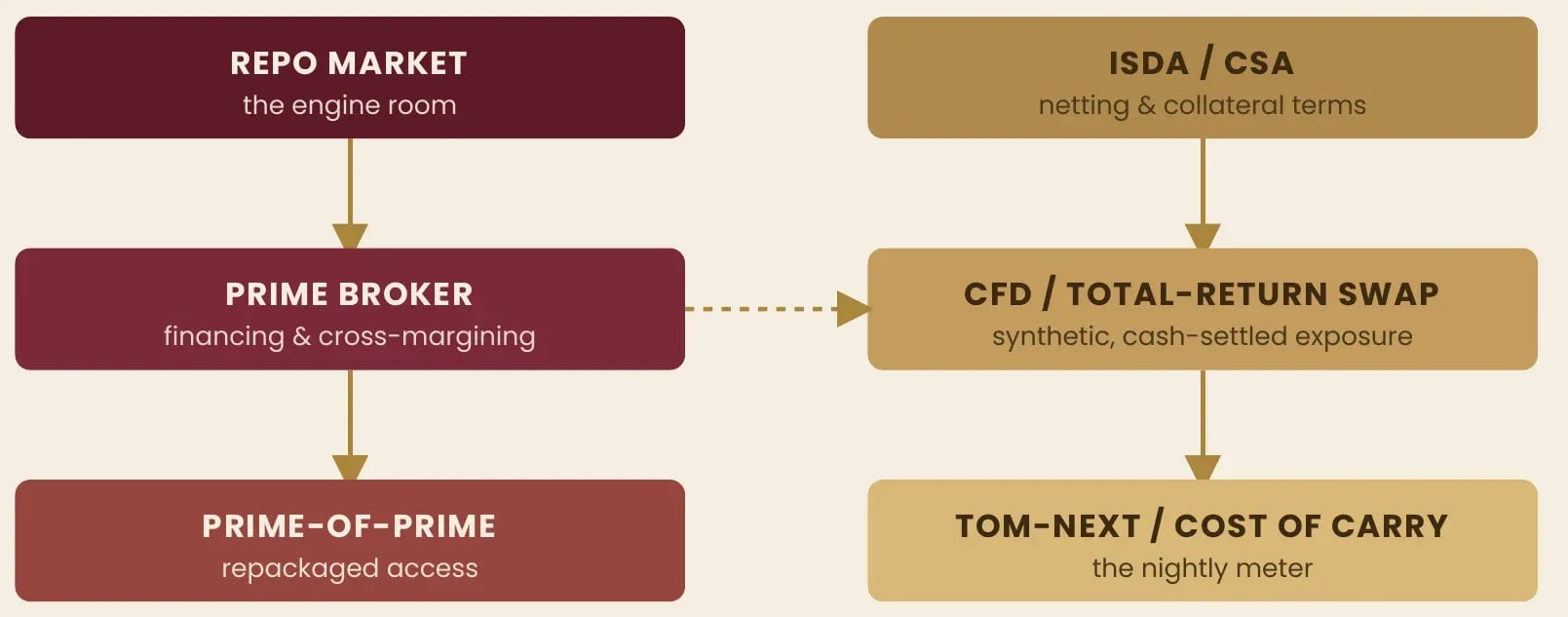
Leverage is not a state of mind; it is a supply chain, manufactured through a few mechanisms that form the plumbing of the levered market. The repurchase market is the engine room: a repo is a sale today with an agreement to buy back tomorrow at a higher price — in substance a secured overnight loan. It lets a holder finance assets on a thin haircut and roll the loan each morning: the most efficient leverage machine ever built, and the most fragile.
Above the trader stands the prime broker, extending financing, securities lending, and cross-margining, and beside it the Prime-of-Prime firm, repackaging that access for those who cannot reach a Tier-1 broker directly. None of this scales without the standard contract — the ISDA Master Agreement and its Credit Support Annex define how trades are netted, how collateral is posted, and how a defaulting counterparty is closed out. Further leverage is built by settling in cash rather than the asset: a contract-for-difference or total-return swap references a price without transferring the underlying, creating exposure that is real in its profit and loss yet synthetic in form.
Exhibit — The Credit Cascade: How Leverage Descends the Chain
Source: X-CHASE · Office of Institutional Intelligence (House Framework)
Leverage Across the Institutional Tiers
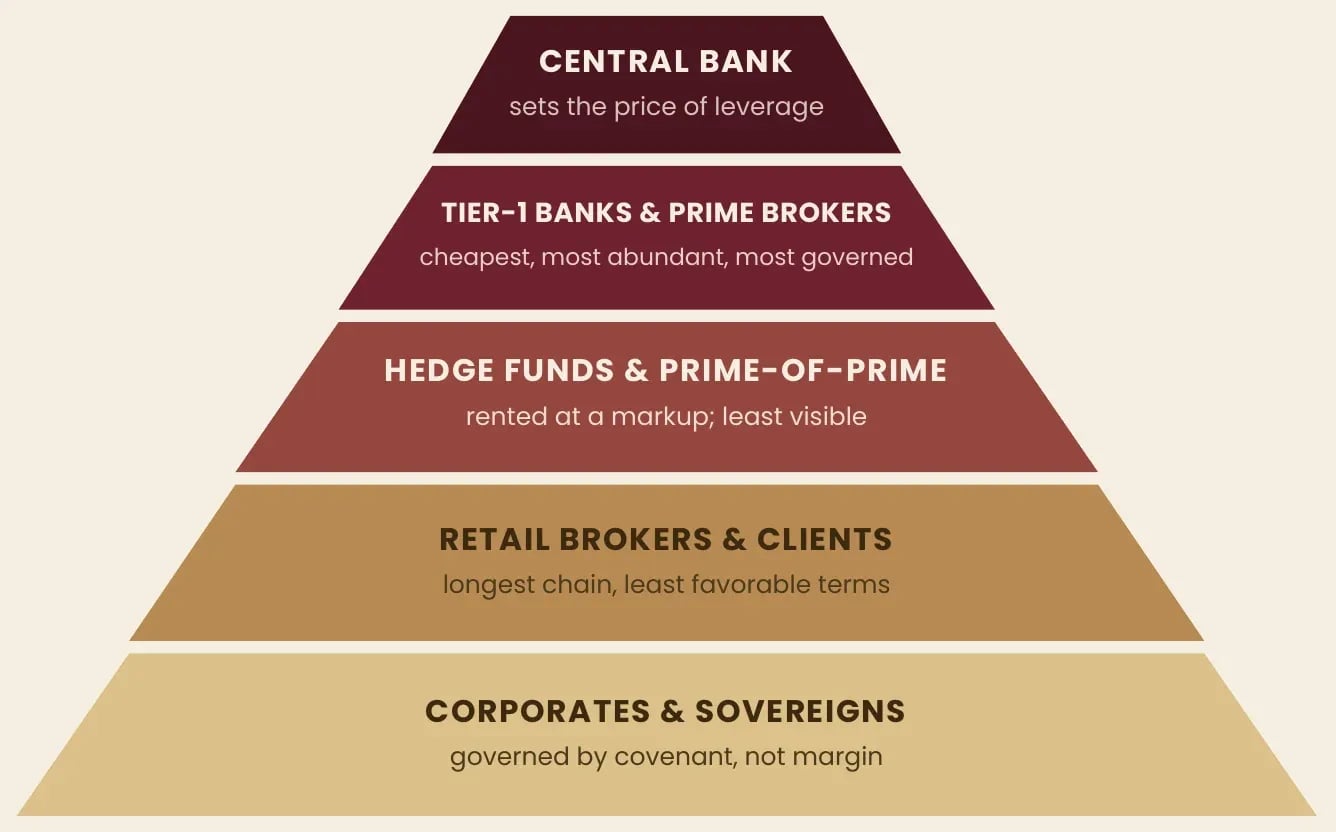
Leverage is not distributed evenly through the system; it is distributed by proximity to the source of money, and its character changes at every rung of the ladder it descends.
At the apex sits the central bank, which does not borrow leverage but issues the base money and the policy rate from which every other tier’s cost of leverage is ultimately derived. Its own operations — repo facilities, standing lending windows, reserve requirements — are the taps that determine how cheaply the tier below it can fund a levered book. The central bank does not use leverage for return; it uses the price of leverage as an instrument of policy.
Below it sit the Tier-1 banks and global prime brokers, the institutions with direct access to the interbank and repo markets, to central clearing, and to the deepest collateral pools. Their leverage is the most heavily governed — bound by the Basel leverage ratio, risk-weighted capital rules, and supervisory stress tests — and, in exchange for that governance, it is also the cheapest and most abundant. A Tier-1 institution can carry balance-sheet leverage of ten to twenty times equity and finance it overnight, because its counterparties trust both its capital and its regulator.
Beneath the Tier-1 layer sit the asset managers, hedge funds, and Prime-of-Prime firms, which do not create leverage but rent it from the tier above, at a markup that reflects their own perceived risk. A hedge fund’s leverage is a function of the credit lines its prime brokers extend, and those lines can be resized or withdrawn far faster than a bank’s own balance sheet can be. This is the tier where embedded leverage is most concentrated and least visible — a fund financed across several prime brokers can carry an aggregate exposure no single counterparty can see in full, the precise structure that turned a single family office’s losses into a multi-bank event in 2021.
Beneath that sit the retail brokers and their end clients, who reach the leveraged core of the market through the longest chain of intermediation and on the least favorable terms. A retail forex or CFD account may be offered leverage of thirty, fifty, or several hundred times deposited capital, but that leverage is manufactured entirely by the broker’s own hedging and credit relationships with its Prime-of-Prime and liquidity providers above it — the retail participant holds a claim on a claim on a claim, several tiers removed from the balance sheet that ultimately absorbs the risk.
Finally, corporates and sovereigns use leverage in a different register entirely — term debt, project finance, sovereign issuance — governed less by margin calls than by covenant, credit rating, and duration matching, but subject to the same underlying law: capital borrowed against future cash flow is capital that must be repaid regardless of whether the future arrives as planned.
The tiers are connected, not independent. A tightening of credit at the apex propagates downward through every tier beneath it, arriving last, and hardest, at the retail account with the least capacity to absorb it.
Exhibit — The Institutional Ladder of Leverage
Source: X-CHASE · Office of Institutional Intelligence (House Framework)
Leverage is cheapest where it is best governed, and most expensive, least visible, and most dangerous exactly where it is least governed.
Dynamic Risk Engineering & Transmission Through Microstructure
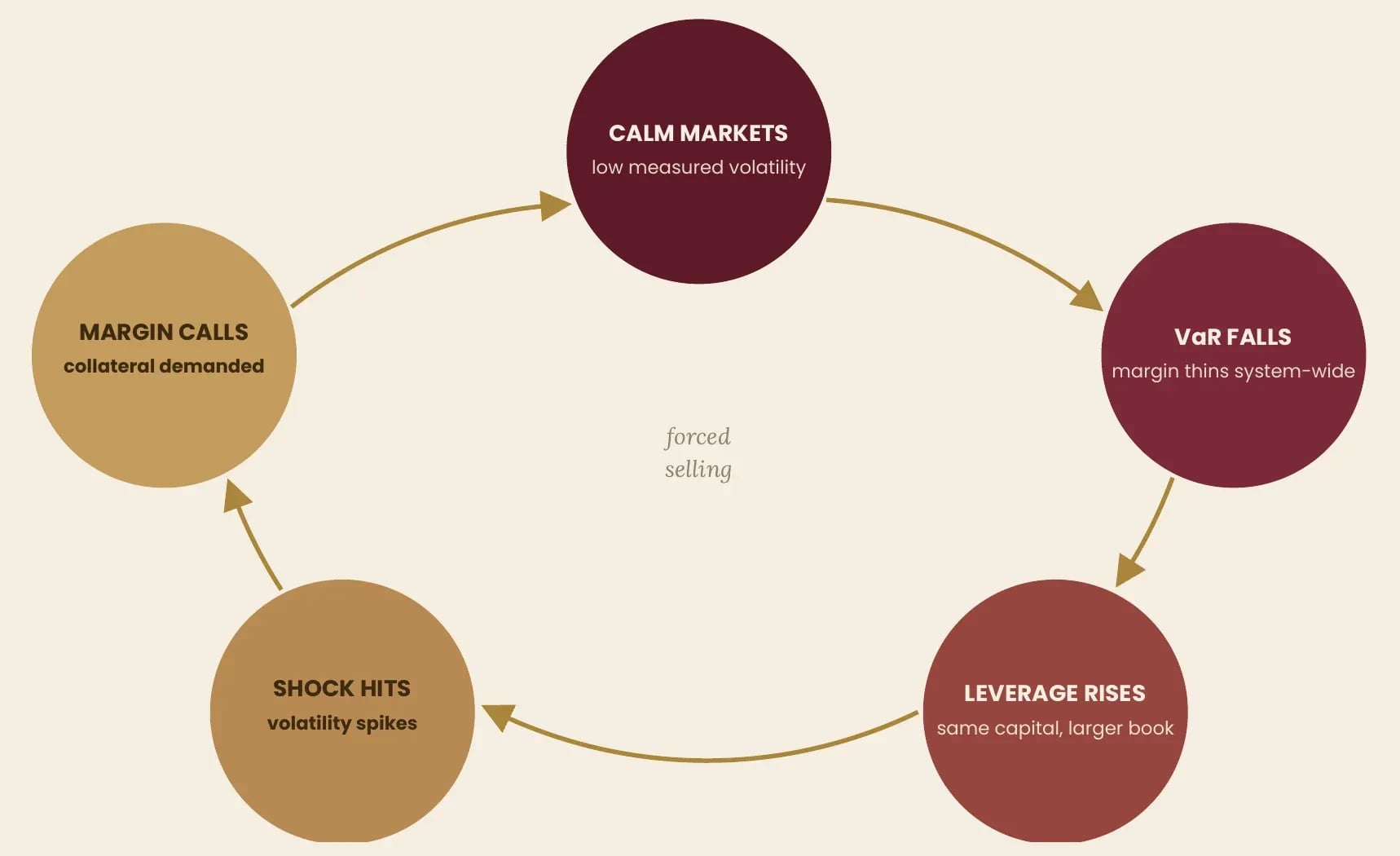
If the infrastructure manufactures leverage, the risk engine is meant to govern it, and the central instrument is Value at Risk. VaR asks: over a given horizon and confidence, what is the most this portfolio can lose? It governs leverage and endangers it in three precise ways. First, VaR is silent about the tail — it manages the risk one can survive and ignores the risk that kills. Second, it is procyclical: calibrated on recent volatility, VaR is low when markets are calm, so the system carries more leverage on the same capital; when volatility spikes, margin rises across every levered book at once. Third, dynamic margin turns this into a spiral — variation margin follows the market daily, so a sharp move triggers a call, which forces a sale, which moves the price further. The canonical demonstration was the collapse of Archegos Capital Management in 2021, where concentrated, embedded leverage across multiple prime brokers, each seeing only its own slice, met a fall it could not survive.
Exhibit — The Procyclicality Spiral
Source: X-CHASE · Office of Institutional Intelligence (House Framework)
Leverage does not stay in the risk report; it reaches the order book. In ordinary conditions it deepens markets — levered market makers carry far larger inventories than their capital alone would permit. When leverage withdraws, the inventory it supported is pulled, and the book thins precisely when it is most needed. The acute form is the margin-call cascade, whose fastest expression is the flash crash.
The Regulatory Architecture
The supervisor’s problem is the mirror of the owner’s: the owner asks how to earn the most on the least capital; the supervisor asks how to ensure enough capital stands behind the system to survive the owner’s success. Regulation of leverage now operates at three distinct levels, each addressing a different tier of the ladder described above.
At the prudential level, Basel III set the modern standard. Because risk-weighted capital ratios proved gameable — banks satisfying every requirement while carrying balance-sheet leverage of thirty times equity in 2008 — the framework added a non-risk-weighted leverage ratio, requiring a minimum of Tier 1 capital against total exposure, on- and off-balance-sheet alike. The global minimum is set at three percent, with higher supplementary requirements for the largest, most systemic banks: risk-weighting for precision, the leverage ratio as a floor that holds when precision fails.
At the market-infrastructure level, a wider apparatus governs how leverage moves between institutions. Dodd-Frank in the United States and EMIR in the European Union pushed standardized derivatives into central clearing and imposed uncleared-margin rules on the bilateral trades that remained. MiFID II added transparency and position-reporting obligations across trading venues, and central counterparties now calibrate margin to stressed, rather than merely recent, volatility — a direct answer to the procyclicality problem.
At the retail level, regulators intervene far more bluntly, capping leverage by instrument rather than by capital ratio. ESMA restricts retail CFD leverage to a maximum of thirty times on major currency pairs across the European Economic Area; the UK’s FCA applies comparable limits; the US framework, through the CFTC and NFA, caps retail forex leverage at fifty times on major pairs; and jurisdictions such as Australia’s ASIC have followed the same pattern. IOSCO coordinates principles across these regimes without harmonizing them fully, which is why leverage limits still vary meaningfully by jurisdiction.
Exhibit — The Three Levels of Regulation
| Instrument | Answers | |
|---|---|---|
| Prudential | Basel III leverage ratio (3% minimum) | How dangerous, and how large. |
| Market infrastructure | Dodd-Frank / EMIR / MiFID II / CCP margin | How leverage moves between institutions. |
| Retail | ESMA / FCA / CFTC-NFA / ASIC caps | Where judgment cannot be assumed. |
Source: X-CHASE · Office of Institutional Intelligence (House Framework)
A risk-weighted rule asks how dangerous the assets are, and trusts the answer. A leverage ratio asks only how large they are, and trusts nothing. A retail cap asks neither, and draws the line where judgment cannot be assumed. The system needs all three.
How Institutions Engineer Leverage to Their Advantage
Regulation sets the floor. What separates a durable institution from a fragile one is what it builds above that floor, voluntarily, before it is required to. The strongest institutions do not treat their leverage limit as a target to approach; they treat the regulatory minimum as the last line of a defense whose first lines are internal.
Capital Allocation Ahead of the Constraint
Tier-1 institutions typically hold leverage buffers well above the regulatory minimum, precisely so that a market shock does not force a breach — and a breach’s consequence is not only supervisory censure but a signal to every counterparty watching that the institution’s own risk appetite has been set with no margin for error. The buffer is a credibility instrument as much as a capital one.
Margin Set Against Stress, Not Against Calm
Where a thin risk model calibrates margin to recent, tranquil volatility, a disciplined institution stress-tests its own book against historical dislocations — the kind that produced the 1998, 2008, 2020, and 2022 episodes catalogued in Section X — and holds collateral against that scenario, not the one currently observed. This is the single most effective private defense against procyclicality, because it refuses to let a calm market set the price of insurance against a storm.
Concentration and Counterparty Limits
The Archegos episode was not a failure of leverage as such; it was a failure of any single institution seeing the whole of a client’s exposure across counterparties. Institutions that engineer leverage well impose hard limits on single-name and single-counterparty concentration, and — increasingly — require disclosure or coordinate informally with other financiers of the same client, treating information about aggregate exposure as itself a risk-management asset.
Diversified, Term-Matched Funding
A funding book built entirely on overnight repo is a funding book built to run at the first sign of stress. Institutions that use leverage as a durable advantage rather than a fragile shortcut deliberately diversify their funding tenor and counterparty base, accepting a marginally higher average cost of funds in exchange for a much lower probability of a forced unwind on any single day.
Contingency Funding as a Standing Discipline, Not a Document
The strongest institutions maintain — and regularly rehearse — a contingency funding plan: pre-identified, pre-negotiated sources of liquidity that can be called on before a crisis, rather than sought during one. The value of the plan is almost entirely in its rehearsal; an untested contingency line is a promise, and promises are the first thing withdrawn under stress.
Leverage as a Strategic Tool, Not a Default Setting
Used well, leverage is not merely tolerated risk but a deliberate instrument of capital efficiency — freeing equity for the next opportunity rather than tying it to the current one, and allowing an institution to compete for scale against better-capitalized rivals without matching their balance sheet dollar for dollar. The discipline is in treating every unit of leverage taken on as a decision with a cost, not as a residual left over once other constraints are satisfied.
Regulation tells an institution how much leverage it may carry. Governance tells it how much leverage it should carry — and the second number is almost always the more conservative one, in every institution built to last.
The Systemic Dimension
No firm’s leverage is, finally, its own. It transmits through the balance-sheet channel, the funding channel, and the collateral channel. Much of the leverage that matters now lives outside the regulated banking sector, in hedge funds, family offices, and pension-linked vehicles, as shadow leverage — economic exposure built through swaps and repo that bank capital rules do not capture.
The Episodes — Four Crises, One Mechanism
| The leverage | The lesson | |
|---|---|---|
| LTCM · 1998 | ~25× balance-sheet leverage atop a trillions-scale derivatives notional, on convergence trades assumed near-riskless. | Model-measured safety is not safety. |
| Lehman · 2008 | ~30× leverage, financed heavily through short-term repo, against assets the models understated. | Funding leverage is solvency on a one-day clock. |
| Gilt / LDI · 2022 | Pension-sector vehicles levered through derivatives to match long-dated liabilities. | A fiscal shock drove a margin spiral in the deepest sovereign market. |
| Archegos · 2021 | Concentrated synthetic exposure through total-return swaps across multiple prime brokers, each blind to the whole. | Embedded, hidden, concentrated leverage is the most dangerous of all. |
Exhibit — Leverage Multiples in Comparative Context
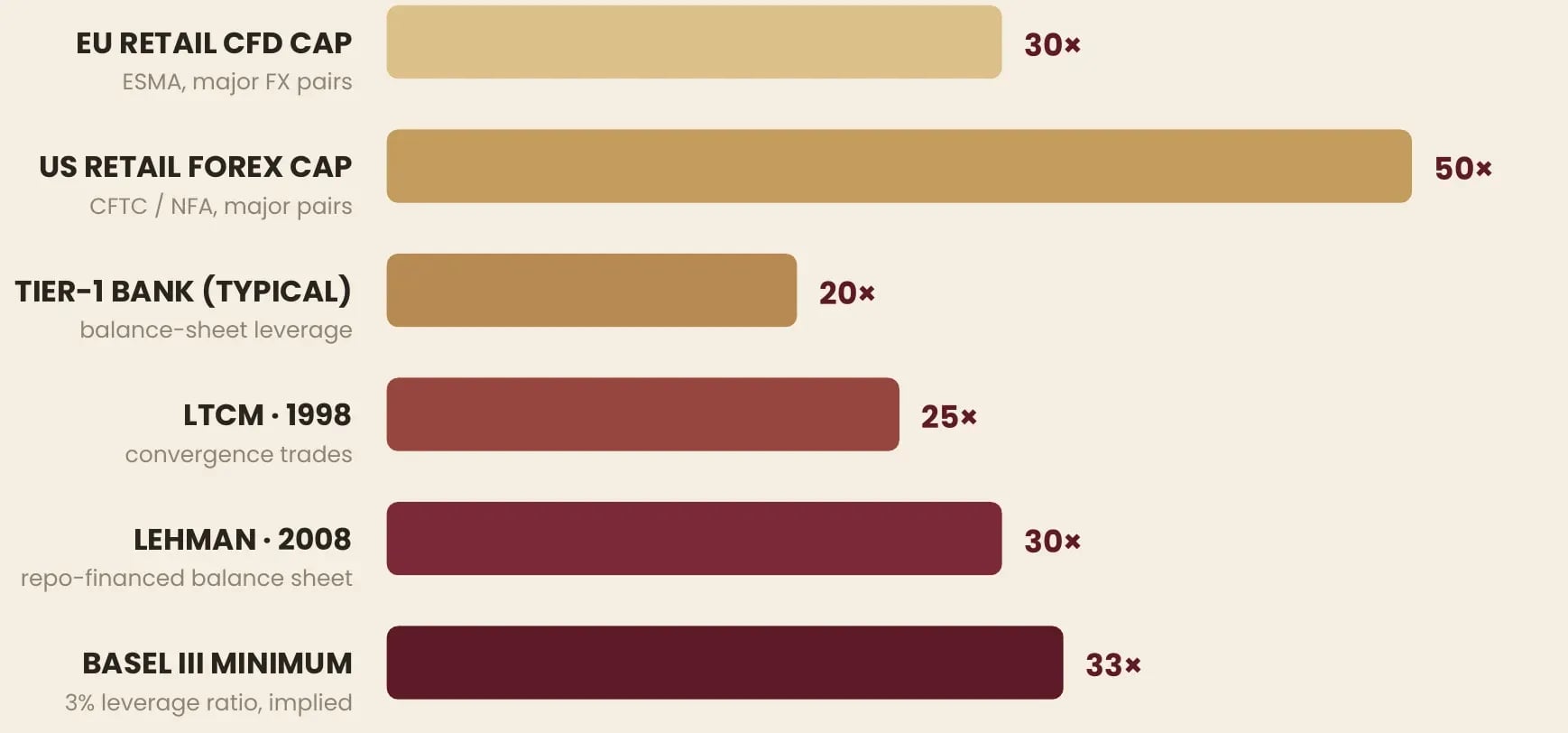
Source: Illustrative multiples compiled from figures cited in this study; not a precision index. X-CHASE analysis.
Every systemic crisis is, beneath its particular trigger, the same event: a leveraged position unwinding through the tiers it had quietly connected.
The Doctrine — Leverage as Creation and as Ruin
We return to the duality, now able to state it precisely, across every level examined above. Leverage is borrowed force, and force is neutral. The same multiplier that lets a central bank calibrate the cost of credit, a Tier-1 bank deepen a market, an allocator finance a productive position, and a retail participant reach a tier they could not otherwise touch is the multiplier that transmits a single failure through every counterparty it has connected. There is no version of leverage that carries only the first set of properties.
This is why leverage cannot be abolished and should not be worshipped. To engineer it responsibly is not to remove it but to build the constraints that keep a position-level event from becoming a system-level failure — at the regulatory level, through capital floors and margin rules that hold when models fail; and at the institutional level, through the private discipline of buffers, stress-tested margin, concentration limits, and rehearsed contingency, which is very often the more binding constraint, because it acts before the regulator ever needs to.
The owner of capital will always seek to earn the most on the least, and so will always carry more leverage than is prudent unless something holds the line. What can be changed is the architecture — who holds the credit lines, how the margin is set, where the leverage is allowed to hide, and how the structure behaves the moment the source of funding is questioned. To build that well is the most consequential and least visible work in finance. It is not the management of a number. It is the engineering of the conditions under which borrowed force creates rather than destroys.
Leverage is borrowed time and borrowed force. It deepens the market in the calm, and empties it in the storm. The advantage belongs to those who build for the storm while trading in the calm.