

THE DOCTRINE SERIES · STUDY NO. 07
The Character of Capital
On why the House reads the principal before it reads the plan — what the record shows when founders are not read, what the House reads and with which instruments, the objections it must answer, and how a reading becomes the design of an institution.
ADMISSION · DOCTRINE

STUDY NO. 07
Abstract
Every institution the House designs, launches, and manages rests on two things it does not supply: the principal’s capital and the principal’s character. The first is examined everywhere. Banks verify it, regulators verify it, and counterparties verify it again before extending a single line of credit. The second is almost never examined at all, although it governs the institution far longer than the capital does. Capital is deployed once. Character decides every day afterwards — how a loss is absorbed, how a regulator is answered, how a bad quarter is explained to staff, and whether the governance written at founding is obeyed or quietly set aside.
This study sets out why X-CHASE reads the principal before it accepts a mandate. It examines what the record shows when founders are not read; describes the six dimensions the House reads, the instruments it relies on, and those it does not; states the terms on which a reading is conducted; answers the objections a serious principal will raise; and shows what the House does with what it learns. The argument is not that some principals are good and others bad. It is that an institution takes on its founder’s temperament more completely than it takes on any document, and that a House which shares in the outcome of what it builds cannot responsibly build without understanding the person it is building with.
The House reads the principal before it reads the plan. The Studiolo is where that reading begins.
Definition · The Three Readings
Character — who the principal is when nothing is at stake, and who the principal is when everything is: integrity, composure, and the habits that appear under pressure.
Vision — the size and shape of what the principal intends to build, the time the principal is prepared to give it, and whether the two are consistent.
Fit — whether the House and the principal can work together across a horizon measured in years: how decisions are made, how advice is received, and how disagreement is resolved.
Capital tells the House what can be built. Character tells it what will survive.
Exhibit · The Course of the Study
- IThe Jockey and the HorsePart One · The Premise
- IIWhy a Partner Reads FirstPart One · The Premise
- IIIThe Failure ModesPart One · The Premise
- IVThe Six DimensionsPart Two · The Reading
- VThe InstrumentsPart Two · The Reading
- VIThe ConversationPart Two · The Reading
- VIIThe Terms of the ReadingPart Two · The Reading
- VIIIHow a Reading Enters the AnswerPart Three · Use
- IXFrom Reading to DesignPart Three · Use
- XThe Name Is the First DecisionPart Three · Use
- XIThe Obligation of SelectionPart Three · Use
- XIIThe ObjectionsPart Four · Judgment
- XIIIThe DoctrinePart Four · Judgment
The Jockey and the Horse
Investors have argued for decades over whether to back the jockey or the horse — the people or the plan. Measured rather than asserted, the professional answer now leans heavily in one direction. In the largest survey of its kind, 885 institutional venture capitalists were asked how they choose investments and what explains the results. The management team was named as an important factor in choosing an investment by 95 percent of firms, and as an important factor in explaining success by 96 percent. Asked to name the single most important factor, more of them named the team than every business consideration combined.
Exhibit 1 — The Single Most Important Factor
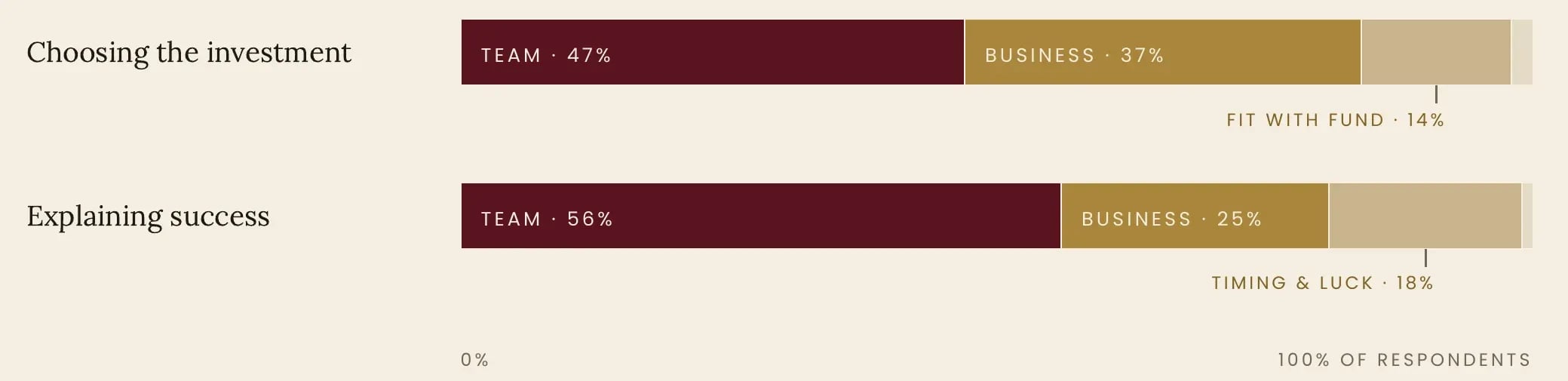
Source: Gompers, Gornall, Kaplan and Strebulaev, “How Do Venture Capitalists Make Decisions?” Journal of Financial Economics (2020); NBER Working Paper 22587. Business combines business model, product, market, and industry. Unlabeled segments are other factors.
The finding is not confined to early-stage investing. A study of chief executives assessed in depth before buyout and venture transactions found that the characteristics most associated with later success were execution skills — persistence, efficiency, follow-through — rather than the interpersonal qualities that tend to dominate a first meeting. And a long line of management research, beginning with the upper-echelons work of Hambrick and Mason in 1984, holds that an organization becomes, over time, a reflection of the people at its top: their values, their blind spots, and their appetite for risk are written into its strategy and its structure.
For the House this is not an academic observation. The institutions X-CHASE builds are founded, not acquired. A brokerage, a family office, or a payment institution in its first five years has no culture except the one its principal brings to it, no risk appetite except the principal’s, and no governance except the governance the principal is prepared to obey. Its policies are drafted by the House. Its temperament is supplied by its founder.
An institution is its founder’s temperament, written down as policy.
Why a Partner Reads First
A firm paid only for its time has a limited interest in its client’s character. It completes the work, issues the invoice, and leaves. The House is not structured that way. In a turnkey mandate, X-CHASE is remunerated in part through a share of the institution’s net profit, agreed privately for each mandate and stated in its written terms. The House is therefore a partner in the outcome for as long as the mandate lasts, and it inherits the consequences of every decision the principal makes — including the decisions made against its advice.
That structure changes the economics of selection. When a firm is paid by the hour, accepting the wrong client is a nuisance. When a firm is paid from profit, accepting the wrong principal is a multi-year commitment of senior attention to an outcome it cannot control. The asymmetry is shown below. Of the four possible results of a selection decision, only one is expensive, and it is more expensive than the other three combined.
Exhibit 2 — The Four Outcomes of Selection
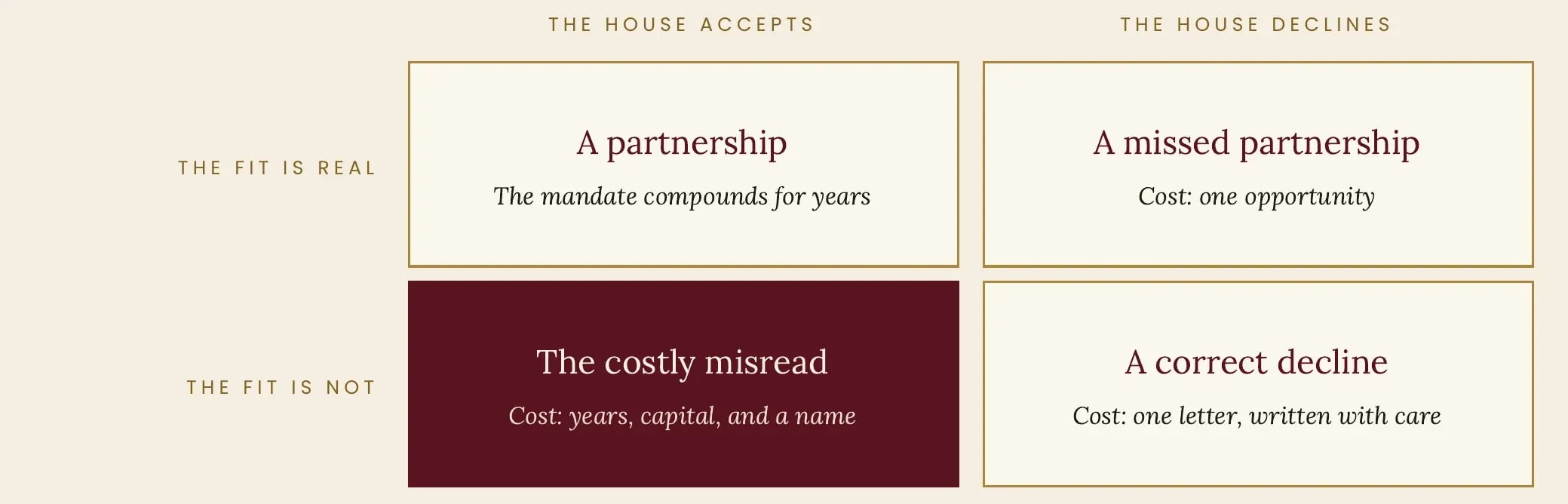
Source: X-CHASE analysis (House Framework).
A missed partnership costs the House one opportunity, and opportunities recur. A correct decline costs a carefully written letter. A misread costs years of work, capital that cannot be recovered, and — because the House’s name stands beside every institution it launches — a measure of its reputation. A House that intends to be selective must therefore be willing to bear the first cost in order to avoid the third. It will sometimes decline a principal with whom it could have worked. It accepts that error deliberately, because the opposite error cannot be undone.
The House would rather miss a partnership than misread one.
The Failure Modes
Founders rarely destroy institutions through a single decision. They do it through a disposition that expresses itself in hundreds of decisions, each defensible on its own. The record shows two kinds of failure, and the House reads for both.
The quiet failure. The first requires no misconduct at all. In a study of 394 large American companies over fifteen years, chief executives classified as overconfident — measured by how they handled their own stock options rather than by anything they said — had odds of making an acquisition 65 percent higher than their peers, concentrated in diversifying deals and in companies with cash to spare. The market reacted significantly more negatively when they announced a bid. Nothing illegal occurred. Shareholder value was simply transferred, deal by deal, from the institution to its leader’s self-assessment.
The loud failure. The second is the collapse that reaches the courts. Four recent cases span the institution types the House builds — an exchange, a family office, a payment institution, and a specialist lender. In none of them was the precipitating cause a market event. In each, the institution had the outward apparatus of governance, and in each, the conduct of the people at its top overrode it. The cases are summarized below and described overleaf, on the basis of court records and official findings only. The House draws no psychological conclusion about any individual; it identifies which dimension of a reading would have carried the warning.
Exhibit 3 — Which Dimension Carried the Warning
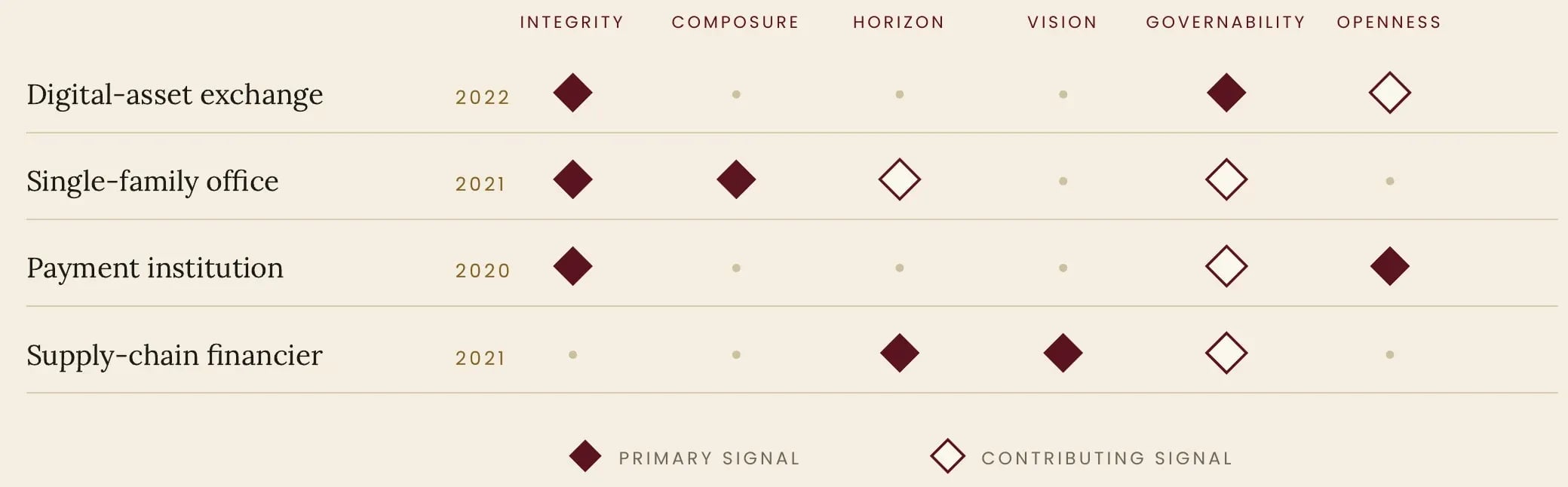
Source: X-CHASE analysis (House Framework), from the public record described below. Assignments are the House’s judgment of conduct, not assessments of any person.
None of these institutions lacked a structure. Each lacked a principal who would live inside it.
The Four Cases
The exchange
Digital-asset exchange · Bankruptcy, November 2022
The executive appointed to lead the exchange through bankruptcy, a restructuring specialist with decades of experience, told the court on his first day that he had never in his career seen “such a complete failure of corporate controls.” His declaration described an institution with no accounting department, payment requests approved by emoji in chat, staff encouraged to use auto-deleting messages, and control concentrated in a very small group. Customer deposits had been moved to an affiliated trading firm. The founder was convicted on seven counts of fraud and conspiracy in November 2023.
Signaled by · Governability · Integrity
The family office
Single-family office · Collapse, March 2021
A family office built concentrated, leveraged positions in a handful of stocks through total-return swaps spread across several prime brokers, none of which could see the whole. When the positions turned, banks lost about ten billion dollars between them; one lost about five and a half billion and later exited the business. An independent investigation commissioned by that bank’s board faulted its own risk management. The founder was convicted of fraud and market manipulation in 2024 and sentenced to eighteen years. The structure was a family office — precisely the vehicle in which nobody outside the family is positioned to say no.
Signaled by · Integrity · Composure · Horizon
“Never in my career have I seen such a complete failure of corporate controls.” — The chief executive appointed in the exchange’s bankruptcy, November 2022
The payment institution
Payment processor · Insolvency, June 2020
A listed payment processor filed for insolvency in June 2020 after its auditor could not confirm €1.9 billion of cash that its accounts said it held. For years beforehand the company had met scrutiny with confrontation; in February 2019, as a financial newspaper reported irregularities, the national regulator banned short selling of its shares and prosecutors opened an investigation into one of the journalists. The institution’s former chief executive was charged with fraud in 2022 and brought to trial in Munich.
Signaled by · Openness · Integrity
The specialist lender
Supply-chain finance · Insolvency, March 2021
Months before it failed, a supply-chain financier was being discussed for a public listing reported at about seven billion dollars. It had become heavily dependent on a single group of clients, extended finance against receivables that did not yet exist, and relied largely on credit insurance from a single source. The insurer signaled in 2020 that it would not renew; the cover, about 4.6 billion dollars, expired in March 2021. Investment funds that had provided around ten billion dollars of its financing were suspended the same week, and the firm entered insolvency.
Signaled by · Horizon · Vision
The market did not end any of these institutions. Each was ended by a disposition the market had financed.
What the Four Have in Common
The structure existed. Each had directors, auditors, or counterparties whose function was to say no.
The warnings were visible. In each case the relevant conduct was observable years, or at least months, before the collapse.
Counterparties read the capital. Banks, investors, and insurers examined balance sheets and collateral. None of them was positioned to read the person.
The signal was readable. In every case, at least one of the six dimensions would have raised the question before the first dollar was committed.
The Six Dimensions
A reading is not a verdict on a person. It is a description of how a person is likely to behave inside an institution, across six dimensions that the House has found decisive in the life of a mandate. Each is read on a continuous scale rather than sorted into a category, because people differ by degree, and because the same trait that strengthens one institution can endanger another.
Exhibit 4 — The Six Dimensions of a Reading

Source: X-CHASE analysis (House Framework). The profile shown is illustrative and describes no real person.
The Six Dimensions
Integrity. Candor, fairness, and modesty about one’s own entitlement — the dimension most closely linked in research to conduct that damages an organization.
Composure. How loss, delay, and criticism are absorbed: whether pressure produces judgment or impulse.
Horizon. The time the principal will give the institution before expecting it to prove itself, and the patience shown in the interval.
Vision. The scale and coherence of what the principal intends to build, and whether ambition is matched by a plan.
Governability. Willingness to be governed by the structures the principal is paying to create: boards, risk limits, compliance, and advice.
Openness. Capacity to learn an unfamiliar industry, to welcome scrutiny, and to change course when the evidence changes.
The Instruments
No single instrument reads a person reliably, and the House relies on none of them alone. A reading combines what principals say about themselves, what validated measures say about them, what people who have worked for them say, and what the House observes over the weeks between a first contact and an answer. Where these agree, the reading is firm. Where they disagree, the disagreement is itself the finding, and it is pursued in conversation rather than settled by a score.
The House distinguishes between instruments that measure and instruments that describe. Validated trait inventories place a person on continuous scales and have been tested against behavior over many years. Popular type indicators sort people into a small number of categories; they are useful as a shared vocabulary, and many principals already know their type and find it a comfortable way to talk about themselves. But a category imposed on a continuous trait discards most of the information, and the same person can be assigned a different type on a later attempt. The House listens to a principal’s type with interest and decides nothing on it.
The choice of model matters, and research on misconduct at work shows why. A meta-analysis comparing the two leading trait models found that the six-factor model, which adds a dimension of honesty and humility to the established five, explained substantially more of the variance in workplace deviance than the five-factor model, and that honesty and humility was the strongest single correlate within it. The House reads integrity as a dimension of its own for exactly this reason.
Exhibit 5 — Variance in Workplace Deviance Explained by Each Model

Source: Pletzer, Bentvelzen, Oostrom and de Vries, Journal of Vocational Behavior 112 (2019), as reported in Pletzer et al., Personality and Individual Differences 152 (2020).
Finance offers its own evidence. A study of 101 hedge fund managers, followed from 2005 to 2015, found that managers with stronger manipulative, self-serving, and callous traits delivered lower returns than their peers — a little under one percent a year — contrary to the popular image of the ruthless investor. The traits that make a person persuasive in a first meeting are not the traits that compound capital over a decade.
Exhibit 6 — The Instruments of a Reading
| What it reads | Role in the reading | |
|---|---|---|
| Structured conversation | Vision, horizon, decision style, and how the principal speaks about past failures, partners, and staff. | Primary. Conducted by the House. |
| Trait inventory | The six dimensions on continuous scales, against a validated reference population. | Principal measure. |
| Pressure profile | Behavior under strain: the strengths that turn into liabilities when stakes rise. | Informs the design of governance. |
| Values and motives | What the principal is building for — wealth, legacy, independence, recognition — and how those motives rank. | Informs fit. |
| References | Accounts from people who have worked for the principal, not only with the principal. | Corroboration. |
| Observation | Conduct across the admission period: punctuality, candor, treatment of junior staff, response to a delay. | Corroboration. |
| Type indicators | The principal’s own preferred language for self-description. | Vocabulary only. Never a ground. |
Source: X-CHASE analysis (House Framework). Instruments are administered and interpreted by qualified practitioners.
A type is a vocabulary. A trait is a measurement. The House converses in the first and decides on the second.
What the House does not read. A reading is confined to conduct that bears on the mandate. It does not extend to health or any clinical matter, to private or family life, to faith or politics, or to any characteristic a principal did not choose. It produces no diagnosis, and it is not therapy. Its subject is how a person decides, not who a person is in any other sense.
Nor is a reading a test that can be passed by preparation. The instruments matter less than the consistency among them. A principal who describes themselves as patient, whose inventory confirms it, whose former staff recount it, and who waits calmly for the House’s answer has been read. A principal whose account and conduct diverge has also been read — and more clearly.
The Conversation
The structured conversation is the center of the reading and the part principals remember. It is conducted by the House, not by a practitioner, and it is not an interview in the hiring sense: it runs in both directions, and the principal is invited to ask the House the same questions. Every question has a purpose, and the purpose is stated here, because a reading that depends on concealment is not one the House is prepared to conduct.
Exhibit 7 — From the Conversation
Eight of the questions the House asks, and the dimension each is meant to read. The full conversation is longer and adapts to the principal.
- I“Describe the institution as you expect it to stand in ten years — and what you would refuse to let it become.”Vision
- II“Tell us about the largest loss you have taken. What did you do in the first week?”Composure
- III“How long will you give this institution before you expect it to prove itself?”Horizon
- IV“Who has the authority to tell you no? When did they last use it?”Governability
- V“When did you last change your mind on something important, and what changed it?”Openness
- VI“What would you never do, even if it were legal and profitable?”Integrity
- VII“Think of someone who left your organization on bad terms. What would they say about you?”Integrity · Composure
- VIII“Whom in your industry do you study, and what exactly would you take from them?”Vision · Openness
What the House listens for is rarely the content of an answer. It is whether a loss is described with ownership or with blame; whether the ten-year institution is specific or merely large; whether the principal can name a person who has said no and been heard. The last question has a second purpose. The figures a principal chooses to study say a great deal about the institution they intend to build, and the answer becomes the starting point for its design.
The Terms of the Reading
A House that asks to read a principal must state precisely where the reading sits in admission and on what terms it is conducted. It sits after the first conversation and before the House gives its answer. It is never part of a first contact: the Antechamber asks for no documents and no assessment, and the reading is not requested until both sides have met and wish to continue.
Exhibit 8 — Where the Reading Sits in Admission
The reading is the third of six steps — after the first conversation, before the answer. Source: X-CHASE Admission Protocol.
- IFirst contactInquiry or Antechamber
- IIFirst conversationSixty minutes
- IIIThe ReadingWith consent
- IVThe answerFrom a named person
- VVerificationDocuments
- VIThe BlueprintDesign begins
The Terms
Consent. The reading is conducted only with the principal’s written consent, given after its purpose and scope have been explained.
Scope. It is non-clinical and confined to the six dimensions. It produces no diagnosis and touches no protected characteristic.
Practitioners. Instruments are administered and interpreted by qualified practitioners, under the House’s confidentiality obligations.
Reciprocity. The principal receives their own report, discussed in person. On request, the House describes the reading of the Mandate Lead who will serve them.
Confidentiality. The report is held by a restricted group within the House, used for no purpose but the mandate, and never disclosed to a third party.
Retention. It is kept only as long as the House’s published retention schedule permits.
Condition. For turnkey mandates, in which the House shares in the outcome, the reading is a condition of acceptance. For single-service mandates it is offered and not required.
Institutional principals. Where the principal is a state body, a central bank, or a regulated institution, the House reads the governing body and its decision process, not an individual.
How a Reading Enters the Answer
A reading never decides a mandate on its own. It is weighed beside three other questions the House asks of every principal — the capital and its source, the purpose of the institution, and the jurisdiction and structure it requires — and the answer is given by a named senior person once all four have been considered. The reading has a particular role among them: it is the only input that describes how the other three will be handled once the mandate begins.
Exhibit 9 — How the Reading Enters the Answer
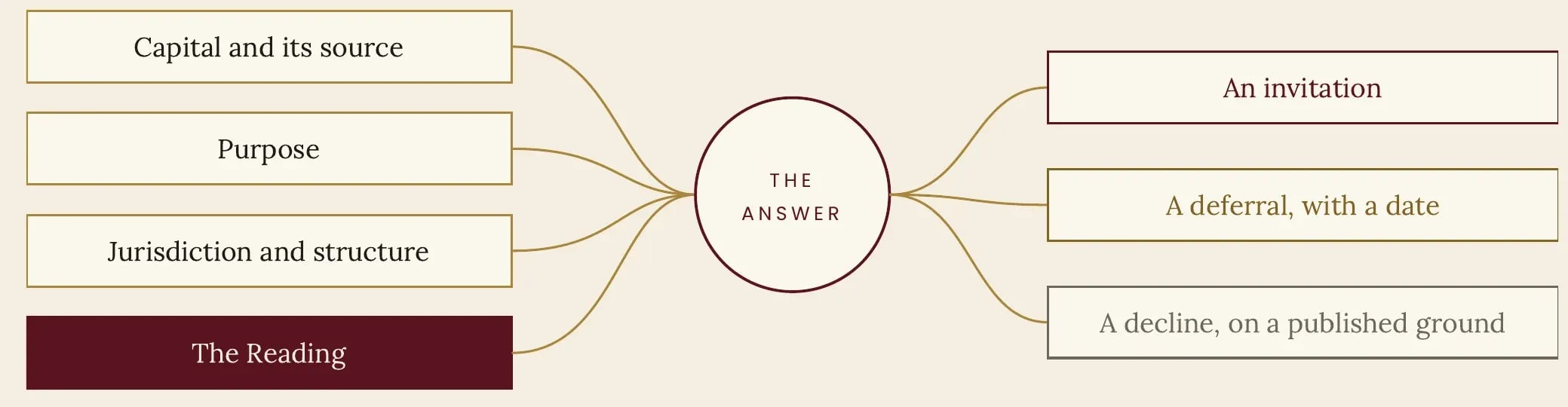
Source: X-CHASE Admission Protocol. Declines are given on one of the five grounds published in the Antechamber.
The answer takes one of three forms. An invitation proceeds to verification and the Institutional Blueprint. A deferral states its reason and a date on which the House will return to the question — often because the reading shows a principal whose vision is ahead of their horizon, and who will be better served by beginning later than by beginning wrongly. A decline is given in writing, on one of the published grounds, without disclosing the content of the reading.
The House holds one further discipline. A reading that is ambiguous is a reason for more conversation, never a reason to decline. The selectivity this study describes is an obsession with accuracy, not with refusal; a House that declined whenever it was uncertain would be selecting principals who are easy to read rather than principals who are good to work with.
Three Things a Reading Never Does
It never decides alone. No mandate turns on the reading without the other three questions.
It is never disclosed in a decline. A decline cites a published ground; the content of a reading is never used as an argument against the principal.
It is never used beyond the mandate. It is not shared with counterparties, introducers, or other principals, and it is not retained for any other purpose.
From Reading to Design
The most valuable use of a reading is not selection. It is design. Once the House has accepted a principal, the reading becomes a specification: every institution is built to carry its founder’s strengths into the market and to place governance precisely where the founder’s blind spots would otherwise do damage. Two principals with identical capital and identical objectives should not receive identical institutions.
Exhibit 10 — From Reading to Design
Where the reading shows, and how the institution is designed. Illustrative responses; each mandate is designed individually.
- Vision ahead of horizonA phased programme with formal gates, and an operating chief who holds authority over sequence.
- A high appetite for riskRisk limits set at board level that the principal cannot raise alone, and a risk function independent of every revenue line.
- Strong control, little delegationA governance charter that names reserved matters, and an early appointment of a deputy the principal chooses and trusts.
- Caution that delays decisionsA decision calendar with dates, and agreed defaults that take effect if no decision is made.
- Discomfort with scrutinyAn audit committee with independent members, and a standing practice of answering critics in writing and on the record.
- Strength in relationshipsDistribution built on the principal’s own network, with the principal as the institution’s senior coverage lead.
- Strength in analysis, reserve in publicA named public face for the institution, with the principal chairing its investment and risk committees.
The same logic governs the human architecture around the principal. A founder strong in vision is paired with operators strong in discipline; a meticulous founder is paired with people who move faster. The reading tells the House which half of the leadership team the principal supplies, and therefore which half it must recruit.
A reading is also not permanent. Principals change as their institutions grow: a founder who needed to control every decision in the first year may be ready to delegate by the third. The House therefore returns to the reading at each gate of the mandate, with the principal’s agreement, and adjusts the institution’s governance to the person its founder has become.
Selection decides whether the House builds. The reading decides what it builds.
The Name Is the First Decision
Before an institution has a license, a platform, or a single client, it has a name — and the name is the first decision it makes in public. The House reads it with the same attention it gives the principal, because the name is usually the principal’s own choice and it reveals a great deal: the scale at which the institution is imagined, the audience it believes it is addressing, and whether it is being built to be trusted or to be noticed.
A name must survive a regulator’s register, a correspondent bank’s onboarding committee, and a sovereign counterparty’s first glance. It must work in each language of the markets the institution intends to serve, and it must still be appropriate when the institution is ten times its founding size. The House therefore treats naming as part of design rather than decoration, and it will say so plainly when a name chosen at founding will limit what the institution can later become.
An institution is introduced by its name long before it is judged by its conduct.
The Obligation of Selection
Selectivity is defensible only if it is reciprocated. A House that reads its principals closely, declines many, and accepts few takes on a corresponding obligation toward those it accepts: to serve them as it serves its own institution. The House does not begin work with every principal who asks, and it does not become a partner to everyone with whom it works. But a principal it has accepted receives what the House would build for itself — the same standard of design, the same care in launch, and the same attention in management, for as long as the mandate lasts.
That is the true purpose of the reading. It is not a filter applied to principals. It is the means by which the House decides where to commit everything it has, and the reason it can make that commitment without reservation once it has decided.
The House does not begin with everyone. Those it begins with, it serves as it serves itself.
The Objections
A practice of this kind invites objection, and a serious principal will raise each of the following. The House states them in their strongest form and answers them here, because a principal entitled to be read is entitled to know how the House would defend the reading.
I · “It is intrusive.”
A partner is entitled to ask what a lender is not. Every principal already accepts verification of wealth, its source, and its ownership — matters at least as private as temperament. The reading is narrower than that verification: it is confined to how decisions are made, it excludes health, private life, faith, politics, and every characteristic a person did not choose, and it is conducted only with consent. The principal sees the result first, and may ask the House to submit to the same reading.
II · “It can be gamed.”
A single inventory can be. A reading cannot, because it does not rest on any single source. Validated inventories carry their own consistency checks; references come from people the principal managed, not only from people the principal chose; and the conversation and the weeks of observation around it test whether the account a principal gives of themselves is the one their conduct confirms. A principal who prepares to appear patient must remain patient for the whole of admission. Most who can do that are, in fact, patient.
III · “It discriminates.”
It reads conduct, not identity. No protected characteristic enters a reading, instruments are normed against broad reference populations, no single score triggers a decision, and every decline is given on a ground the House has published in advance. The discipline is stricter than the informal judgment it replaces: every firm forms an impression of a principal at the first meeting, and most never examine it. The House examines its impression, writes it down, and tests it.
IV · “Senior principals will refuse.”
Some will, and the House accepts that cost. Principals of standing tend to recognize the practice, because they apply it to every senior appointment in their own organizations. Where the principal is a state body or a regulated institution, the House reads the governing body and its decision process rather than a person. And for a private principal seeking a partner who will share in the outcome, a refusal is not a decline. It is, however, information.
V · “Character cannot be measured.”
Not precisely, and the House does not claim to. Trait measures predict conduct moderately, not perfectly; the strongest correlate in the research cited here explains a meaningful share of misconduct and leaves most of it unexplained. But the alternative to an imperfect reading is not certainty. It is an unexamined first impression, formed in an hour by people with an interest in the mandate proceeding. The reading is valuable not because it is exact but because it is deliberate, corroborated, and written down.
VI · “The House will select principals who agree with it.”
The opposite is intended. Governability is not agreeableness. The House reads for principals who will be governed by the structures they create — boards, limits, and independent functions — and it values principals who argue with the House on the record and lose gracefully, or win. A principal who agrees with everything in admission has told the House very little.
The question is never whether a principal is judged. It is whether the judgment is made deliberately, and in the open.
The Doctrine
Every institution the House builds rests on capital it does not supply and character it cannot change. The capital is verified because counterparties require it. The character is read because the House, as a partner in the outcome, cannot afford to leave it unexamined — and because the record shows that no structure, however carefully drafted, survives a founder who will not live inside it.
The reading is therefore conducted with consent, confined to how a principal decides, interpreted by qualified practitioners, and held in confidence. It never decides alone. It does not reward principals who are easy to read, and it does not penalize principals who are complex. Its first use is to decide whether two parties can work together for years. Its second is to decide whether the House should accept. Its third, and most valuable, is to decide how the institution should be built — so that it is carried by its founder’s strengths and protected from its founder’s blind spots.
The House chooses few. It reads them carefully. And having chosen, it builds for them as it would build for itself.
Capital can be raised. Character must be found. The institution is built between the two.
The House reads the principal before the plan. The plan is only as strong as its author.
Closing · The Position of the House
This study has argued that an institution takes on its founder’s temperament, that the record of recent collapses is a record of temperaments overriding structures, that a House which shares in an institution’s profit must therefore read its founder before it builds, and that the reading is most valuable not as a filter but as a specification for design.
X-CHASE holds that position in practice. Every turnkey mandate begins with a reading of the principal, conducted after the first conversation and before the House’s answer, on the terms set out in Section VII. Every Institutional Blueprint that follows carries the reading into the institution’s governance, organization, and leadership design. And every principal the House accepts receives the full measure of its work for the life of the mandate.
Design before procurement. Reading before design.
To Understand the House
The Antechamber, at x-chase.com/antechamber, sets out the House’s terms, protocols, and grounds for declining, and may be read by anyone before any agreement.
To Begin
A principal may submit an inquiry at x-chase.com/submit-an-inquiry, or enter a record in the Antechamber. Each is read by a member of the House.
Standing Disclosure
X-CHASE is an institutional financial systems firm. It is not a regulated financial institution, bank, broker, asset manager, or authorized investment advisor, and nothing in this study constitutes investment, legal, regulatory, tax, medical, or psychological advice. The principal reading described here is a non-clinical assessment of decision-making conduct for the purposes of a mandate. It is not a psychological diagnosis or treatment, it is conducted only with consent, and its instruments are administered and interpreted by qualified practitioners.
Apparatus
A Note on Sources
Investor decision-making. Paul Gompers, Will Gornall, Steven N. Kaplan, and Ilya A. Strebulaev, “How Do Venture Capitalists Make Decisions?” Journal of Financial Economics (2020); NBER Working Paper 22587 (2016). Survey of 885 institutional venture capitalists conducted between November 2015 and March 2016. Figures in Exhibit 1 are from the paper’s tables on investment selection and on the attribution of success.
Executive characteristics. Steven N. Kaplan, Mark M. Klebanov, and Morten Sørensen, “Which CEO Characteristics and Abilities Matter?” Journal of Finance (2012); NBER Working Paper 14195.
Upper echelons. Donald C. Hambrick and Phyllis A. Mason, “Upper Echelons: The Organization as a Reflection of Its Top Managers,” Academy of Management Review 9, no. 2 (1984).
Overconfidence. Ulrike Malmendier and Geoffrey Tate, “Who Makes Acquisitions? CEO Overconfidence and the Market’s Reaction,” Journal of Financial Economics (2008); NBER Working Paper 10813. Sample of 394 large U.S. firms, 1980 to 1994.
Trait models and conduct. Jan Luca Pletzer, Margriet Bentvelzen, Janneke K. Oostrom, and Reinout E. de Vries, “A meta-analysis of the relations between personality and workplace deviance: Big Five versus HEXACO,” Journal of Vocational Behavior 112 (2019); and Pletzer et al., Personality and Individual Differences 152 (2020), which reports the figures shown in Exhibit 5.
Traits and investment performance. Leanne ten Brinke, Aimee Kish, and Dacher Keltner, “Hedge Fund Managers With Psychopathic Tendencies Make for Worse Investors,” Personality and Social Psychology Bulletin (2018). Study of 101 hedge fund managers, 2005 to 2015.
The four cases. The exchange: first-day declaration of the chief executive appointed in its Chapter 11 proceedings, United States Bankruptcy Court for the District of Delaware, November 2022, and the verdict in the founder’s criminal trial, Southern District of New York, November 2023. The family office: the report of the independent investigation commissioned by the board of Credit Suisse Group, July 2021, and the founder’s conviction and sentence, Southern District of New York, 2024. The payment institution: the company’s own announcements of June 2020, the actions of the German financial regulator and Munich prosecutors in February 2019, and the charges brought in 2022. The specialist lender: public reporting of the insolvency proceedings of March 2021 and of the non-renewal of its credit insurance.
Why the cases are unnamed. The institutions are identified by type rather than by name, and no individual is named, because the purpose of Section III is to show patterns of conduct relevant to institutions the House builds rather than to comment on persons. Every fact stated is drawn from court records, official findings, or the institutions’ own disclosures. Where a criminal proceeding had not concluded at the time of writing, none is stated as concluded.
House frameworks. The six dimensions, the four outcomes of selection, the assignment of signals in Exhibit 3, the instrument weighting, the conversation in Exhibit 7, and the design responses in Exhibit 10 are House frameworks and are identified as such wherever they appear. They are not survey data. The profile in Exhibit 4 is illustrative and describes no real person.
Named instruments. No assessment provider is named in this study. Reference to trait models and type indicators describes categories of instrument in general use; no affiliation, endorsement, or commercial relationship is stated or implied.
Disclaimer
This study is published by the Office of Institutional Intelligence of X-CHASE for informational purposes. It does not constitute investment, legal, regulatory, tax, medical, or psychological advice. X-CHASE is not a regulated financial institution, bank, broker, asset manager, or authorized investment advisor. Research findings are summarized from the published sources listed above; readers should consult those sources directly before relying on them. Nothing in Section III states or implies any finding about any person beyond what the cited public record states.